
Choosing a Technology Partner for Digital Transformation
Choosing a technology partner for digital transformation: evaluation criteria, evidence of technical depth, reference interview questions, red flags and the partnership's first 90 days.
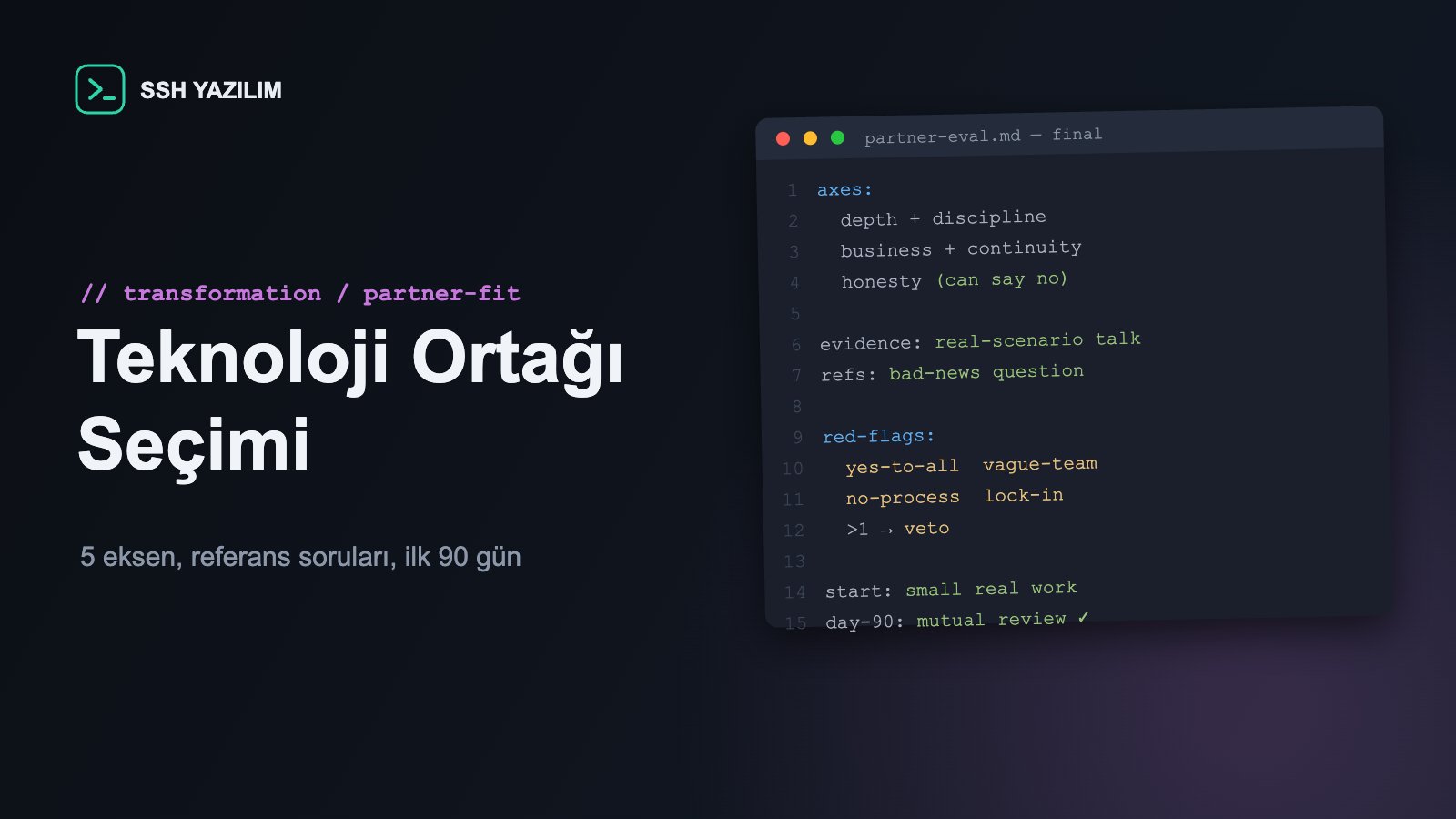
What separates a technology partner from a vendor?
A vendor takes orders and delivers; a partner shares the business goal and enters into responsibility for technical decisions: 'we built what you asked for' is vendor language, 'you asked for this, but here is why we recommend that' is partner language. Because digital transformation is a multi-year journey, the distinction is critical — needs change along the way, and you need a party that will tell you the truth when they do. This closing article of our series gathers the criteria of the previous nine into a single evaluation framework.
The evaluation framework: five axes
Axis | What to look for | How to ask for evidence |
|---|---|---|
Technical depth | Domain expertise (platform, integration, scale) | Case walkthroughs + architecture conversation + written output (blog/guides) |
Engineering discipline | Testing, CI/CD, monitoring, security practices | Sample project process narrative; definitions (done, acceptance) |
Business understanding | Tying technical decisions to business outcomes | Quality of answers to 'why'; ability to discuss TCO |
Continuity | Team stability, knowledge-transfer culture | Meeting the team; handover/AMS approach |
Honesty | Knowing limits, ability to say no | Deliberately posing hard/unsuitable scenarios |
Evidence of depth: conversation, not presentation
Sales decks are the weakest evidence of competence; strong evidence emerges when you make them talk. The practical method: put a scenario from your own reality on the table ('our order line chokes like this on campaign day' / 'we have postponed the Hybris upgrade for three years') and watch the discussion — a good partner asks questions (scope, constraints, data), discusses options with pros and cons (like the decision tables across this series), and says 'we would need to look' where they do not know. Written output is a strong signal too: technical blogs, guides and open methodology show both depth and a teaching culture. The weak signals are just as clear: 'yes, we can' to every question, name-dropping technologies without discussing patterns, an 'we do everything' catalog without reference architectures.
Reference interviews: the right questions
The reference discipline from our platform selection article applies here — but the questions differ, because you are investigating a way of working, not a product: 'How did they behave when the plan slipped?' (transparency), 'Did they deliver bad news on time?' (honesty), 'Did their team stay stable through the project?' (continuity), 'Can your own team operate the system since handover?' (knowledge transfer — the exit criterion from our modernization article) and 'Would you work with them again, and why?' (the total verdict). Two or three interviews at similar scale beat one shining reference: patterns show.
Red flags: the early warning list
Warning signs fixed by experience: yes to everything (if scope/timeline/budget are never questioned, the questioning gets invoiced during the project); the vague team (seniors in the sales meetings, strangers on the project — no named answer to 'who will actually work on this'); processlessness ('we'll sort it out' as the answer to testing/acceptance/monitoring questions); dependency architecture (evasiveness on source code, documentation and access — resistance to the separation scenario from our contract article); and the price chasm (an offer far below competitors has usually either under-read the scope or planned its recovery in change requests). Each alone can be explained; several together are decision data.
The first 90 days: the partnership's real test
Selection does not end at signature — the first 90 days are the relationship's real due diligence, and well-constructed, they shrink the risk: a small but real starting engagement (an assessment, a health check or a bounded development — showing the working style before any big commitment), establishing the rituals (weekly status, a metric dashboard, an escalation path), observing the first hard moment (how the first slip or piece of bad news was communicated) and a mutual day-90 review (continue/fix/part — the ease-of-exit clause makes that decision free). The phased contract construction (our previous article) is this approach's commercial skeleton: trust grows step by step with commitment.
Business impact: the right partner is leverage
In digital transformation, partner quality is not a one-project difference but compound leverage: sound architectural decisions return as scale and speed for years (every article in this series is an inventory of those decisions), honest counsel cuts wrong investments early, and knowledge transfer grows your own organization's competence. The wrong partner's cost compounds at the same scale — and its bill usually arrives three years later, at the most expensive moment to switch. Care spent on selection is the highest-yield line item in a transformation budget.
Frequently asked questions
Large firm or boutique expert team?
Scale is not always quality: large integrators are strong on breadth, boutiques on depth and access to seniors. The right question is fit, not size: the depth your problem requires, the actual team allocated to you, and access to decision-makers.
Single partner or multiple vendors?
A single accountable partner on the critical backbone + specialist vendors on the periphery is the balanced model. A many-headed backbone produces ownerless failures; total dependence on one vendor makes the separation scenario expensive — balanced through contract discipline.
Should we consider partners abroad?
Worth considering; the criteria are identical, two axes get heavier: communication/timezone reality and local context (regulation, integration ecosystem, language). A blended model (local partner + global resources) is a frequently working balance.
We are unhappy with our current partner; how is a transition managed?
Takeover discipline as described in our AMS article: knowledge transfer + a shadow period + an access inventory. A health check before the transition clarifies for both sides what is being taken over — and the delivery clauses in your existing contract show their value at exactly this moment.
Partner selection checklist
Five-axis evaluation (depth/discipline/business/continuity/honesty) completed
Depth tested through a real-scenario technical conversation
2-3 references at similar scale interviewed with the right questions
Red-flag scan done; more than one is a veto
Named team, process definitions and metric dashboard settled
Small starting engagement + day-90 review planned
Contract: phased model + separation scenario + knowledge transfer
SSH Yazılım builds long-term technology partnerships in SAP Commerce/Hybris, enterprise Java and e-commerce architecture — every article in this series is an open statement of how we work. Let us plan your transformation journey together.