
PCI DSS in E-Commerce: A Payment Security Architecture Guide
PCI DSS for e-commerce platforms: scope reduction strategies, tokenization and hosted payment fields, web skimming (Magecart) defense and the KVKK/GDPR intersection.
What is PCI DSS and who does it bind?
PCI DSS (Payment Card Industry Data Security Standard) binds every organization that processes, transmits or stores card data; it is governed by the PCI SSC, the card schemes' joint body. Major version 4.0 was published in 2022, version 3.2.1 was retired in 2024, and revision 4.0.1 has been released. Every business selling online is in scope — even with payments fully outsourced; what changes is only the level of obligation.
The strongest strategy: shrink the scope
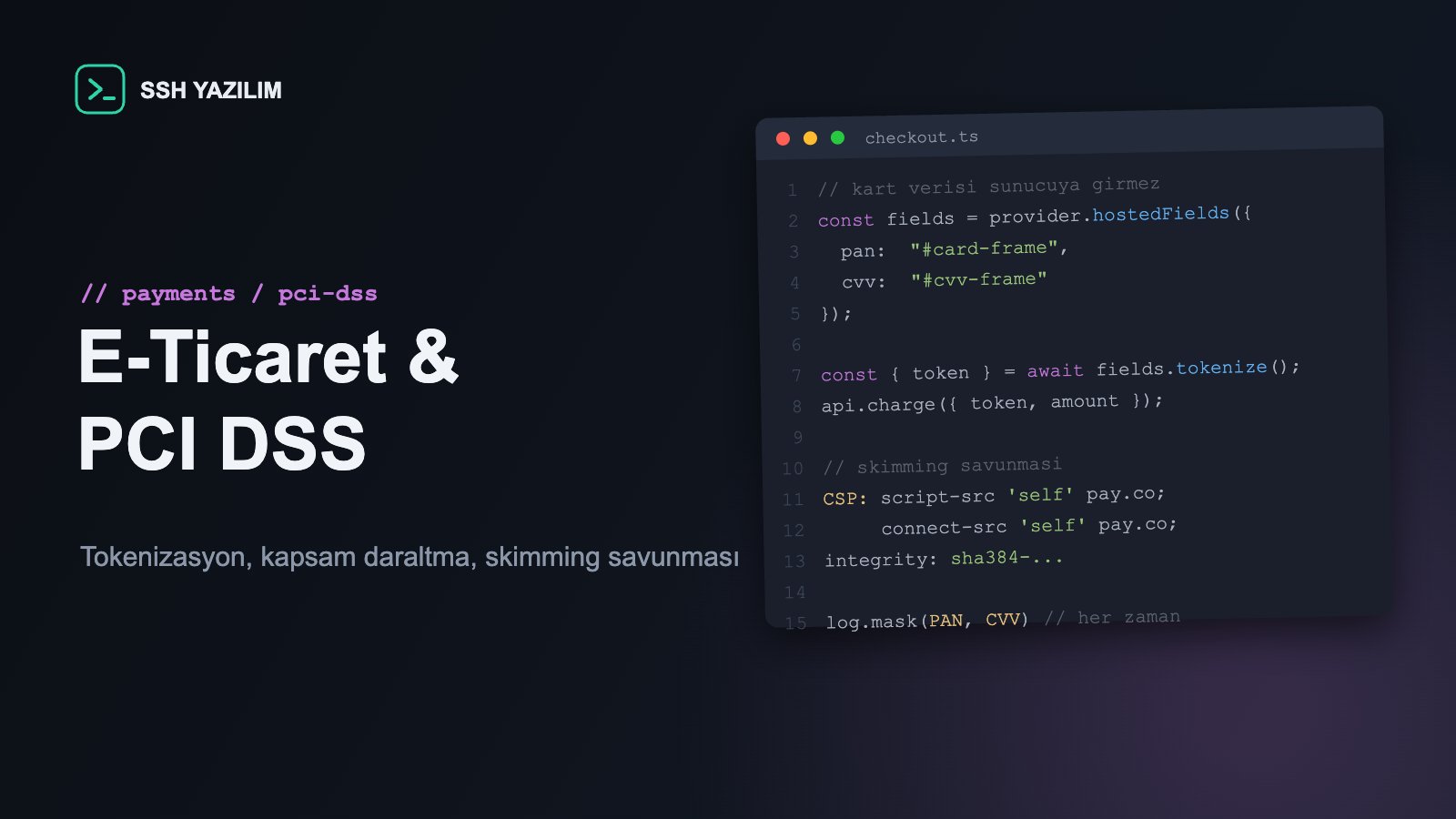
The cost of PCI DSS compliance is proportional to the number of systems that touch card data. That is why the first security decision of a modern e-commerce architecture is: card data should never enter your infrastructure. The tools are tokenization (the card represented by a meaningless token issued by the payment provider), hosted payment pages, and iframe-based hosted fields. If the card number never reaches your servers, your compliance burden drops to the lightest self-assessment levels.
Integration model | Where is card data? | Scope effect |
|---|---|---|
Full redirect / hosted page | Entirely at the payment provider | Narrowest scope |
Hosted fields (iframe) | Fields at the provider, page on your side | Narrow scope; page integrity is critical |
Direct API processing | Card data passes through your servers | Widest scope and obligations |
Web skimming (Magecart): e-commerce's silent thief
Web skimming is JavaScript injected into a payment page copying card details as the form is filled and sending them to the attacker; the attack waves known as Magecart have hit hundreds of thousands of sites. One of the best-known outcomes is the £20 million fine the UK regulator issued to British Airways after its 2018 incident. The critical point: even iframe/hosted fields do not fully protect you if your page is compromised — which is why PCI DSS 4.x made payment-page script inventory, authorization and integrity monitoring, along with change-detection mechanisms, explicit requirements.
Defense layers for the payment page
The practical defense set has four layers: minimizing and inventorying third-party scripts on the payment page; restricting script sources and data destinations with CSP; integrity verification on critical scripts; and monitoring page changes wired to alerts. These layers are also the field implementation of the relevant 4.x requirements.
Storage, logging and masking rules
Where card data is processed, the base rules are clear: if PAN must be stored, it is stored under strong encryption with separated key management; sensitive authentication data (CVV, full track data) is never stored after authorization; PAN never lands in logs, error messages or analytics tools; masking is applied on screens. Leaks into logs are among the most frequent audit findings — build log-masking filters from the start.
Intersection with KVKK/GDPR: two regimes, one architecture
Card data is also personal data: PCI DSS's technical controls and KVKK/GDPR's legal obligations meet in the same architecture. A breach creates liability toward both the card schemes and the data protection authority; retention limits, access records and data inventories are shared expectations of both regimes. Designing one security architecture with both lenses avoids paying twice.
Frequently asked questions
I fully outsourced payments; does PCI DSS still bind me?
Yes — your scope narrows but your responsibility continues: the integrity of your payment page, the security of the redirect, and your annual self-assessment obligation remain.
Is storing tokens the same as storing cards?
No; a provider token is not card data, and it is the right tool for recurring payments and one-click experiences. You still must protect your tokens against account takeover.
Does 3-D Secure replace PCI DSS?
No; 3-D Secure manages fraud risk and liability, it does not replace the infrastructure security standard. The two are complementary.
Which self-assessment (SAQ) applies to me?
It follows your integration model: full-redirect/hosted models qualify for the narrowest forms, direct API processing carries the fullest obligations. Confirm with your payment provider and acquiring bank.
Payment security checklist
An integration model chosen where card data never enters your infrastructure
Payment page script inventory produced; third parties minimal
CSP and script integrity controls active in the payment flow
Page change monitoring and alerting in place
PAN masking; logs scanned for card data
Verified that CVV and sensitive authentication data are never stored
KVKK inventory mapped to PCI scope
SSH Yazılım provides end-to-end consulting on payment architecture design, PCI scope reduction and web skimming defense for e-commerce platforms. Let us harden your payment flow together.