
Software Supply Chain Security: The World After Log4Shell
Lessons from Log4Shell, event-stream and dependency confusion: SBOM, lockfile discipline, CI scanning, version policy and defending the software supply chain.
What is a supply chain attack?
A supply chain attack breaks in not through the target's own code, but by compromising the libraries it uses, the package registries, the build tools or the update channels. In a modern application, most of the code comes from outside — that is the price of productivity: your entire dependency tree is your attack surface.
Five real cases that teach the lesson
Case | Year | Mechanism | Lesson |
|---|---|---|---|
event-stream (npm) | 2018 | Attacker took over maintenance, added a malicious sub-package | Maintainer handover is a risk signal |
dependency confusion | 2021 | Publishing internal package names publicly to poison builds | Internal registries and namespace protection are essential |
ua-parser-js (npm) | 2021 | Maintainer account hijacked, malicious versions published | Version pinning and delayed updates have value |
Log4Shell (Java) | 2021 | Critical flaw in a ubiquitous library (CVE-2021-44228) | Without inventory there is no response speed |
colors/faker (npm) | 2022 | Maintainer deliberately sabotaged his own packages | Single-person dependency is fragility |
SBOM: answering "which version do we run?" in seconds
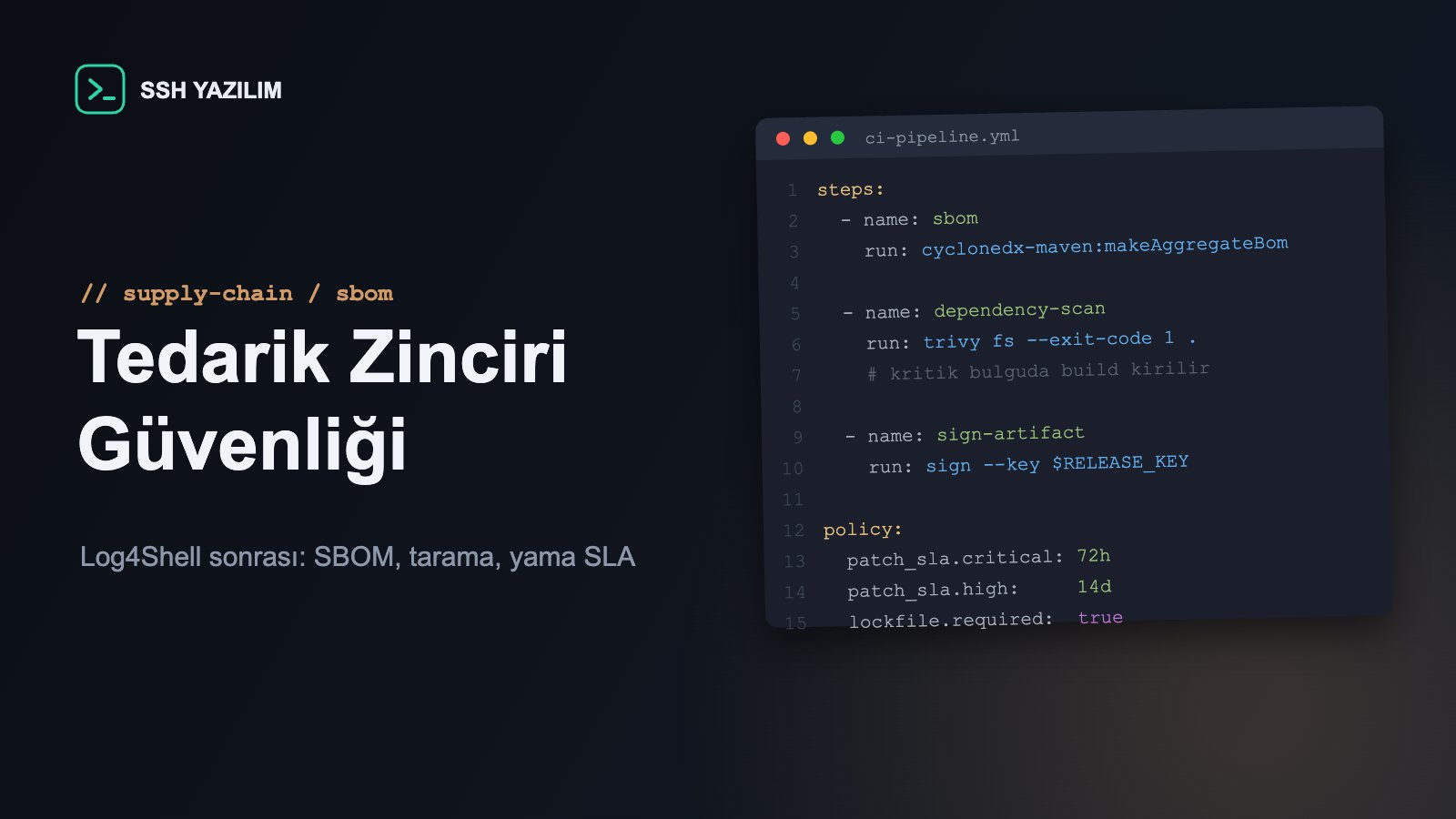
The real divide on the night of Log4Shell was this: some teams listed which service ran which Log4j version within minutes; others grepped repositories for days. The difference was the SBOM — a software bill of materials generated automatically on every build, in CycloneDX or SPDX format. An SBOM does not protect by itself; what it provides is the visibility that closes the gap between a vulnerability disclosure and your response.
Lockfiles and version discipline
Centrally pinning versions with a BOM/dependencyManagement on the Java side, and keeping package-lock under version control on the npm side, are non-negotiable: builds must be reproducible. Update strategy needs balance — take security patches fast, but apply a short waiting window to freshly published versions (most hijack cases are caught within the first hours). Automation bots (Dependabot/Renovate) implement that balance through human-approved PRs.
The CI pipeline: where scanning belongs
Dependency vulnerability scanning (OWASP Dependency-Check, Trivy and similar) must be a mandatory CI step, not something on a developer's laptop; failing the build on critical findings turns policy from debate into automation. Two complementary controls join it in the same pipeline: restricting package install scripts, and signing produced artifacts (images/jars) with verification in the delivery channel.
A patch SLA: from good intentions to measurable process
"We patch quickly" is not a process. A process is: a defined patch-time target per severity (e.g. critical: 48-72 hours, high: 2 weeks), recorded exceptions, and delays reported as an engineering metric. That is exactly what vendor audits ask for.
Business impact: your customers now ask about your chain
Enterprise procurement questionnaires now ask for SBOM sharing, your dependency policy and your patch SLA; in public sector and finance these demands are turning into contract clauses. A software house that can document supply chain discipline clears security review fast — one that cannot fights the same questions on every deal. The return on this investment is both risk reduction and sales velocity.
Frequently asked questions
Should I share my SBOM with customers?
In enterprise scenarios where it is requested, yes — sharing under NDA is common practice. Even if you cannot share it, producing it internally is what determines your response speed.
Should I take every update immediately?
Take security patches fast and feature releases after a short observation window. What matters is binding the decision to automation and written policy.
How do I protect internal packages from dependency confusion?
Prioritize your internal registry, reserve internal namespaces (scopes/groupIds) on public registries, and configure builds so they cannot fall through to public repositories for internal names.
Is using open source risky?
The problem is not open source; it is unmanaged dependencies. Thanks to its transparency, open source with the right process is more auditable than closed alternatives.
Supply chain checklist
SBOM generated on every build (CycloneDX/SPDX)
Lockfiles / BOM under version control; builds reproducible
Vulnerability scanning in CI; build fails on critical findings
Update bot with human approval; waiting window for fresh releases
Internal namespaces protected; internal registry prioritized
Severity-based patch SLA written and reported
Artifact signing with verification at delivery
SSH Yazılım provides end-to-end support in building supply chain security processes — SBOM, CI scanning, version and patch policy. Let us harden your chain together.