
Choosing an Enterprise E-Commerce Platform: SAP Commerce and Alternatives
Enterprise e-commerce platform selection guide: at which scale SAP Commerce (Hybris) is the right call, composable/headless alternatives, TCO items and a decision framework.
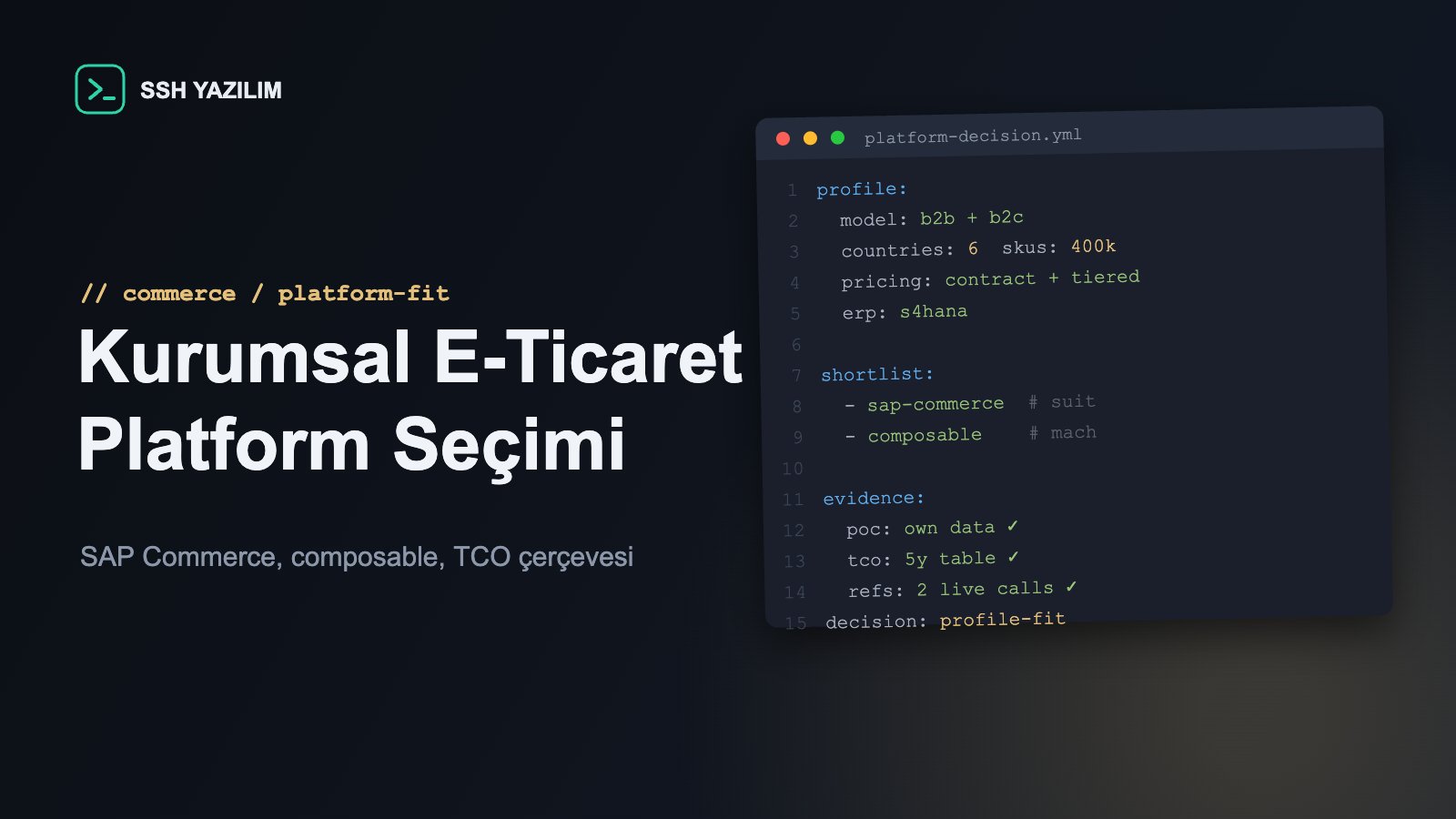
How is an enterprise e-commerce platform chosen?
Not by comparing feature lists — by putting your business model's complexity, your team's reality and the five-year total cost of ownership (TCO) on the same table. A wrong platform decision is the most expensive one to reverse in enterprise commerce: migration projects run on the scale of years and seven-figure budgets. This guide builds the decision framework impartially, drawing on our experience in the SAP Commerce (Hybris) ecosystem — without giving every scale the same answer.
Business model first: requirements choose the platform
The platform debate is not a technology debate; it starts with an inventory of questions: B2B, B2C, or both? How many countries, currencies, tax regimes? How many catalogs, how many SKUs, what depth of variants/configuration? How complex is pricing (customer-specific price lists, contract prices, tiered discounts)? What is the ERP/CRM/PIM integration load? Do order flows carry enterprise patterns — approval chains, split shipments, dealer stock? The sum of this inventory is your 'complexity profile' — and that profile determines the platform class: buying an enterprise suite for a simple profile wastes money; buying a light platform for a complex profile builds a project graveyard.
Platform classes: an honest comparison
Class | Character | Where it shines | Its price |
|---|---|---|---|
Enterprise suite (SAP Commerce) | Integrated B2B/B2C, PIM, promotions, order management | Complex catalog/pricing, SAP ecosystem, multi-country | License + expert team; heavy for small operations |
Composable/headless (MACH) | Best-of-breed services combined | Frontend freedom, selective scaling, fast experience iteration | Integration ownership is yours; demands orchestration maturity |
Mid-market ready platform | Fast setup, standard flows | Standard B2C, limited customization needs | Hits the wall on enterprise patterns (B2B, complex pricing) |
Custom build | From scratch, full control | A unique business model no platform models | You build every commerce capability yourself |
When is SAP Commerce the right answer?
In our experience the profile that justifies SAP Commerce is clear: B2B weight (account hierarchies, contract pricing, approval workflows, quick order — built-in strengths of the suite), catalog/pricing complexity (multiple catalogs, deep variants, rule-based promotions), the SAP ecosystem (deep S/4HANA/ECC integration needs — standard integration content saves months) and multi-country operations. That profile can also be served by a composable setup, but assembling service by service what the suite provides out of the box shifts the integration cost onto you. The reverse is equally true: for a single-country, standard-B2C brand wanting fast campaign cycles, justifying SAP Commerce's license + expertise load is hard — composable or mid-market is the healthier answer there. The impartiality note: the right question is never 'which platform is good' but 'which fits this profile'.
Composable/headless: freedom, with the bill attached
The composable approach (whose architecture we built in our headless commerce article) carries real advantages: frontend technology decouples, experience iteration accelerates, components scale independently. For an honest balance sheet we write the price too: contract, version and integration management for as many components as you have; orchestration responsibility for cart-stock-price consistency; and observability investment for 'which component?' diagnosis during incidents. Composable is freedom for teams with strong platform engineering; chosen as an 'escape from the suite' without that maturity, it becomes a distributed maintenance burden.
TCO: the real five-year cost
Comparison is made not with one year of license but five years of totals: license/subscription + implementation project + integrations + infrastructure/hosting + internal team and external consulting + version upgrades + operations (maintenance, security, monitoring). Two items are systematically under-counted: expertise cost (the pool of experienced SAP Commerce developers is narrow and valuable; in composable, integration engineering is perpetual) and upgrade/evolution cost (version upgrade projects in suites, component replacement cycles in composable). In the decision deck all these items must appear in a year-by-year table — 'the license is cheap but the project is expensive' surprises are caught early in that table.
The decision process: evidence-based selection
A healthy selection process has three stages. Elimination: the complexity profile narrows the class (in most enterprises, 4 classes become 2). Evidence: a PoC with real scenarios on the remaining candidates — your catalog, your most complex pricing rule, a sample integration with your ERP; your data, not the sales demo. References: at least two live-usage interviews at similar scale and industry — especially with the question 'how was the upgrade/change experience?'. The output of this process is not just a platform; it is a team plan, an integration map and a first-year roadmap.
Frequently asked questions
We have an existing Hybris investment; should we move to composable?
Not on fashion grounds. If the current setup serves the business, modernization (version upgrade, taking the frontend headless) is usually more rational than full migration; migration belongs on the agenda only when a profile-platform mismatch is proven.
Who should make the platform decision?
Neither IT alone nor marketing alone: business model owners + architecture + operations together. The decision framework and the TCO table are that table's shared language.
What is a realistic project duration?
A wide range by scale: a standard-scope enterprise implementation runs in months; multi-country, deeply integrated programs are split into phases. Phased go-lives beat big-bang at every scale for risk.
What does independent consulting add to this process?
Evidence produced with your profile, outside vendor decks: PoC scenario design, TCO validation and reference interview questions. Its cost is negligible next to the cost of a wrong platform decision.
Platform selection checklist
Complexity profile inventory completed (B2B/B2C, catalog, pricing, integrations)
Platform classes eliminated by profile; shortlist down to 2
Real-scenario PoC run with each candidate
Five-year TCO table prepared with all items
Reference interviews held at similar scale
Team/expertise plan written alongside the platform decision
Phased migration roadmap and success metrics defined
SSH Yazılım runs enterprise e-commerce platform selection independently — profile analysis, PoC design and TCO evaluation — and delivers SAP Commerce projects end to end. Let us make your decision with evidence.