
Headless E-Commerce Architecture: When It Makes Sense
The headless/composable commerce decision: a real cost comparison of monolithic storefronts vs API-first architecture, the Hybris + OCC path, migration signals and a decision table.
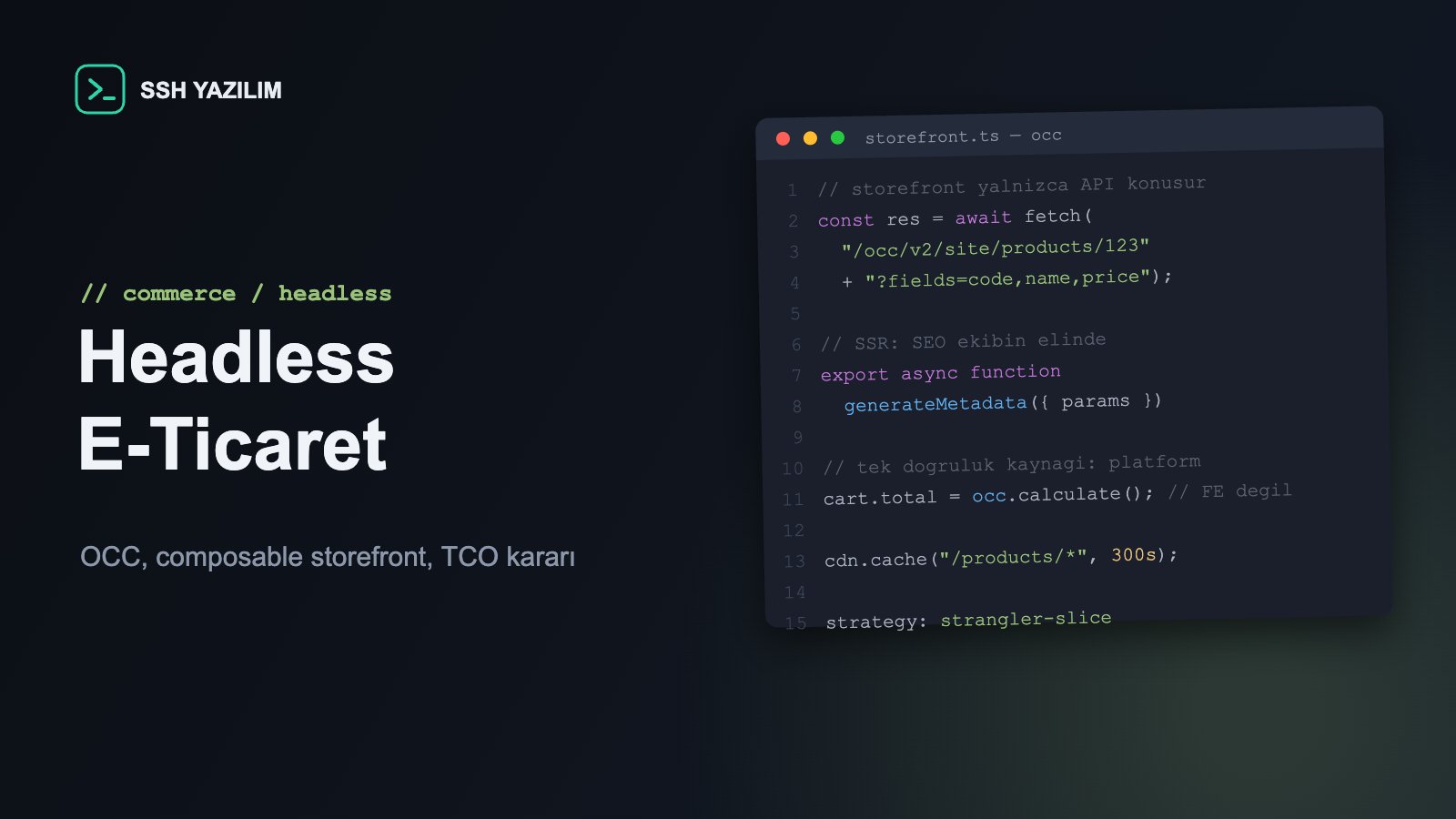
What is headless commerce — fashion or necessity?
Headless architecture separates the storefront from the commerce platform, letting them talk only through APIs; composable is the far end of that separation, where every capability (search, cart, CMS, payment) is assembled from a separate service. Both are powerful in the right context and expensive in the wrong one. This article moves the decision from marketing slogans to engineering and cost.
What are you buying, and what are you paying?
The gains are real: the frontend team decouples from the platform's release calendar; the same APIs serve web, native apps, kiosks and more; the frontend gains modern framework freedom. The price is real too: capabilities the platform gave you for free — page management, personalization, preview — must be rebuilt or bought separately; SEO, caching and performance responsibility moves to the frontend team; and you now operate two production systems (storefront + platform). The decision is the weight of these two lists in your context.
The decision table
Situation | Monolithic storefront suffices | Headless signal |
|---|---|---|
Channel need | One web channel; mobile web is enough | Native app, kiosk, marketplace — multi-channel |
Frontend team | Small team productive in the platform stack | Separate, strong frontend team and design system |
Release cadence | Frontend and platform can ship together | Frontend wants daily, platform monthly |
Experience differentiation | Standard commerce flows suffice | Experience is the main competitive weapon |
Operational capacity | Running one system is already demanding | Maturity to run two production systems exists |
The headless path in the SAP Commerce world
In Hybris projects, headless is possible without replacing the platform: the OCC REST API layer provides the storefront contract; SAP's composable storefront line (evolved from open-source Spartacus) offers a ready Angular base, while teams that prefer React/Next.js build their own. Critical engineering notes: OCC response field configuration is the control point for both performance and data exposure; a CDN caching strategy for anonymous endpoints must be designed up front; and server-side logic such as promotion/cart calculation is never duplicated in the frontend — the platform remains the single source of truth.
SEO and performance: responsibility changes hands
In a monolithic storefront, page generation lives in the platform; in headless, the technical side of SEO (SSR/SSG, meta management, structured data, speed metrics) belongs to the frontend architecture. That is not bad news but a transfer of responsibility: a headless frontend built correctly on an SSR framework like Next.js can beat the monolith on Core Web Vitals — a badly built one pays in rankings. At decision time, "whose sprint owns SEO?" must have a clear answer.
The incremental path: slices instead of a big bang
The move to headless can also be sliced strangler-style: one experience surface first (say campaign pages or the mobile app) goes through OCC while the rest of the storefront keeps flowing monolithically. This model rehearses two-system operations at small scale and shows return on investment early. Full composable — search, CMS, payment as separate services — is rational only for teams that pass this rehearsal with proven integration maturity.
Business impact: the speed promise is weighed against TCO
Headless sales decks promise "faster experience, faster teams"; the balance sheet shows the second system's license/infrastructure cost, the frontend team cost and integration maintenance. The honest accounting is total cost of ownership over a three-year horizon: development + operations + opportunity cost. When the revenue effect of experience differentiation is measurable (conversion, basket, return visits), the headless investment defends itself; when it is not, defer the decision — the cheapest moment of an architecture decision is the moment it is not made.
Frequently asked questions
Is headless always faster?
No — speed comes from correct SSR/caching, not from the architecture label. A badly built headless site can be slower than a well-tuned monolith.
Can I go headless without leaving Hybris?
Yes; OCC + a composable storefront is exactly that path. Your platform investment keeps its value on the backend.
Are composable and headless the same?
Headless is the frontend-platform separation; composable assembles all capabilities from separate services. There is no composable without headless; but not every headless project must become composable.
Should a small team try headless?
With one channel and a small team, usually not: the burden of operating two production systems overshadows the gain. Wait for the need signals first.
Decision checklist
Channel roadmap (web/mobile/other) written with 24-month clarity
Frontend team capacity and design system maturity assessed
SEO/performance ownership and SSR strategy defined
OCC field configuration and CDN caching plan produced
Single-source principle for server-side business logic preserved
Incremental slice (first surface) and its success metric chosen
3-year TCO comparison completed
SSH Yazılım provides headless/composable assessment, OCC architecture and storefront migration planning for SAP Commerce-based projects. Let us ground your decision in data.