
Hybris Health Check: How Is Your SAP Commerce Project Doing?
SAP Commerce (Hybris) health check guide: an audit framework across performance, code quality, version and technical debt, security and operations — red flags and an improvement roadmap.
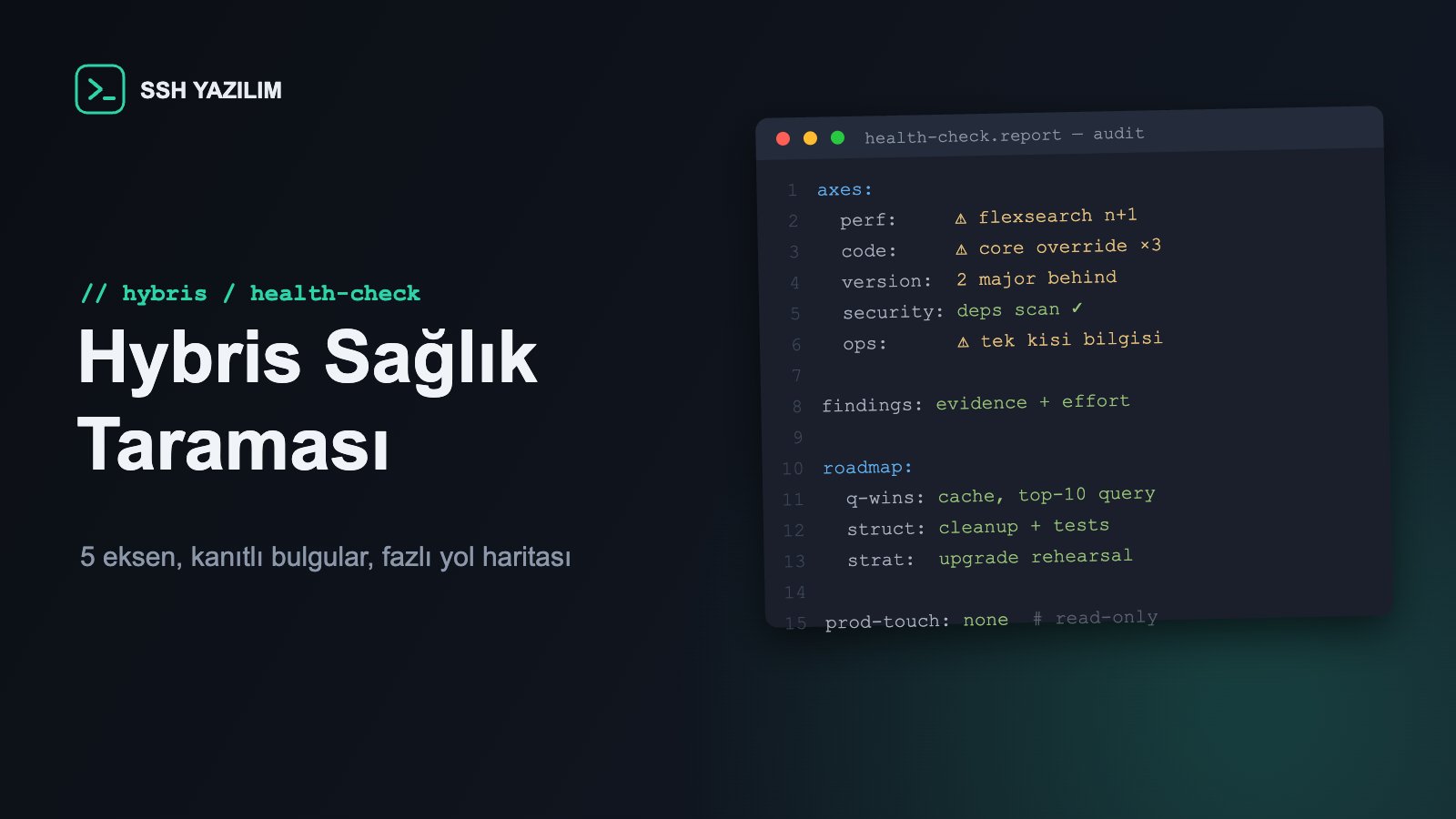
When does a Hybris project need a health check?
Now, if the symptoms are familiar: pages slowing on campaign days, regression cycles stretching with every release, modules nobody dares touch, a version upgrade perpetually postponed, and critical knowledge held by one person. Each is manageable alone; appearing together, a systematic audit — a health check — is the only reliable way to map the accumulated risk. This article shares, transparently, the audit framework we use on SAP Commerce projects.
The audit framework: five axes
Axis | What is examined | Typical evidence source |
|---|---|---|
Performance | Page/API latency, FlexibleSearch patterns, cache hit ratios | APM data, slow query logs, load tests |
Code quality | Customization architecture, core interventions, test coverage | Static analysis, code review, build outputs |
Version & technical debt | Platform/JDK versions, deprecated APIs, patch status | Version inventory, dependency analysis |
Security | Authorization, input handling, dependency vulnerabilities, secrets | Scanners + sampled code audit |
Operations | Monitoring, deployment pipeline, backup/rollback, knowledge silos | Runbooks, incident history, team interviews |
The performance axis: Hybris-specific suspects
Our general Java performance methodology (from the profiling article) combines here with platform knowledge. The recurring Hybris patterns are well known: FlexibleSearch indiscipline — queries inside loops (the platform's N+1), giant unpaginated result sets, unindexed attribute filters; cache configuration — region sizes left at defaults, hit ratios never watched; ImpEx and cronjob load — heavy synchronizations landing in business hours, jobs locking each other; and Solr query cost — facet/boost tangles turning search into the page bottleneck. The output is not the word 'slow' but an evidenced ranking: which endpoint, which query, which fix, which estimated gain.
Code quality: auditing the customization architecture
What sickens Hybris projects over the years is usually not the platform but the customization style. The red flags we look for: out-of-the-box classes copied and modified (the first sin — it makes upgrades impossible), everything piled into one custom extension, data access bypassing the service layer straight to DAOs or Jalo remnants, interceptor/event logic becoming a dumping ground for business rules, and near-zero test coverage on critical flows. The green flags are equally clear: addon/extension boundaries matching business areas, core touched only through configuration and official extension points, a service layer with contracts. This axis's output is never 'rewrite it' — it is a map of the dirty zones and a staged cleanup plan.
Version and technical debt: upgradeability is an asset
The version axis asks two questions: where are you today, and is there a road forward from there? The trio of old platform version + old JDK + unsupported dependencies is not just a security risk but a compounded migration cost — one that grows non-linearly, because every skipped version's breaking changes accumulate. The check includes a version inventory, a count of deprecated API usages (build warnings + static analysis) and an 'upgrade rehearsal' (a trial upgrade in a test environment to measure the breakage surface). The strangler approach from our legacy modernization article is the backbone of the roadmap here too.
Security and operations: the quiet risks
On the security axis our OWASP framework lands in Hybris context: backoffice/hac access authorization, input handling (especially ImpEx and FlexibleSearch injection surfaces), dependency vulnerability scanning, and the state of secrets (API keys, database passwords) in configuration. The operations axis asks the questions of the outage moment: what does monitoring actually see (are the three pillars from our observability article present), can a deployment be rolled back, has restore-from-backup ever been rehearsed, and how many people hold the knowledge? A 'single person who knows the system' finding is a business continuity risk as serious as technical debt, and the report labels it so.
The output: a roadmap, not a score
A health check's value lies in the treatment plan, not the diagnosis. The report ships in three layers: an executive summary (state per axis, the top 5 risks, with business impact); a finding inventory (each finding: evidence + impact + effort estimate + priority); and a phase plan — quick wins (weeks: cache tuning, critical query fixes), structural improvement (months: customization cleanup, test safety net, monitoring setup) and strategic moves (version upgrade, architectural transformation). Every phase produces value on its own — the plan never falls into the 'all or nothing' trap.
Frequently asked questions
How long does it take, and what does it need from our team?
A few weeks depending on scope; it needs read access (code, APM, logs), sample data and a few hours of interviews per axis. Production is never touched.
What guarantees the report's impartiality?
The methodology's transparency: every finding ties to evidence, and a 'rewrite' recommendation is only ever presented alongside the cost comparison of staged alternatives. The goal is enabling a decision, not selling work — part of the quick wins your internal team implements itself.
What if there is no performance data on the live system?
Then the check's first step is building the measurement (APM + slow query logs); two to three weeks of data is the precondition of a sound diagnosis. An audit without measurement is a prescription without an examination.
Does this apply to SAP Commerce Cloud (CCv2) projects?
Yes — the axes are the same; the operations axis deepens into cloud configuration (build/deploy pipeline, environment management, service quotas).
Health check checklist
APM and slow-query data present, or its setup planned
FlexibleSearch/N+1 and cache-hit analysis done
Customization architecture mapped; core interventions listed
Version inventory + deprecated API count + upgrade rehearsal complete
Security scan (dependencies + access + injection surface) done
Operations audit: monitoring, rollback, knowledge-silo risk
Three-layer report: summary + evidenced findings + phased roadmap
SSH Yazılım delivers independent health checks and improvement roadmaps for SAP Commerce (Hybris) projects, and implements them from quick wins to version upgrades. Let us see your project's real state together.