
Java Modernization Consulting: From Assessment to Roadmap
How enterprise Java modernization consulting works: current-state assessment, risk/value prioritization, a phased roadmap, the blended-team model and success metrics.
When should modernization consulting come onto the agenda?
The signals appear on the business side before any technical-debt dashboard: feature delivery times stretch year over year, security/compliance audits keep pointing at old versions, the group that knows the critical system keeps shrinking, and 'let's not touch that system' becomes a normal sentence in meetings. At that point the question is no longer 'should we modernize' but 'in what order, at what risk, on what budget' — and external consulting's value begins exactly there: turning the investment into a defensible plan. This article covers the consulting side of our technical Java 8→21 guide: how the process itself works.
The assessment phase: a state photograph in two to four weeks
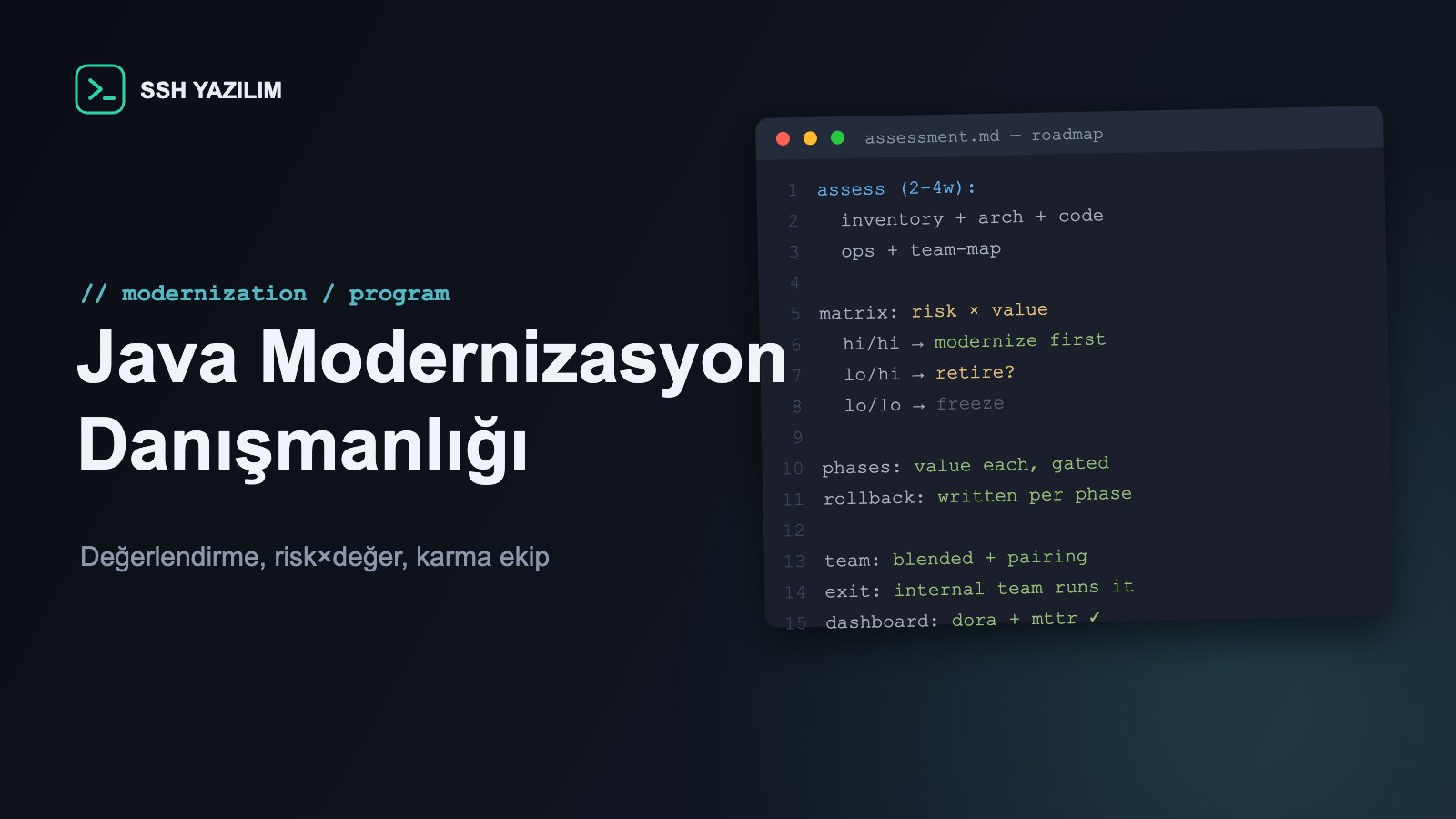
A healthy modernization program starts with the discipline of our health check article, adapted to the Java estate at large: an inventory (applications, versions, dependencies, infrastructure — including the JDK inventory from our licensing article), an architecture photograph (module boundaries, shared databases, the integration web), code health (static analysis + critical-flow review + test coverage), operational reality (deployment process, monitoring, incident history) and a team map (who holds which knowledge, which single-person risks). The output is a state report fit for the board: per system, a risk score + business criticality + modernization option.
Prioritization: the risk × value matrix
System profile | Approach | Typical first move |
|---|---|---|
High business value + high risk | Priority modernization | Test safety net + upgrade rehearsal |
High value + low risk | Planned evolution | Gradual updates in maintenance windows |
Low value + high risk | Retirement/replacement evaluation | Scope reduction, off-the-shelf comparison |
Low value + low risk | Freeze and watch | No touch beyond security patches |
Applying this matrix honestly is consulting's most valuable output: a program that tries to modernize every system finishes none. 'Freeze' is a decision too, and it must be written down.
The roadmap: phases, gates, rollback points
The strangler fig approach from our technical guide translates into a program like this: every phase produces independent value (there is no phase that is only 'infrastructure preparation' — each phase ends with a system upgraded or a capability gained); between phases there are decision gates (with metrics: test coverage targets, performance regression limits, outage budgets); and every phase has a written rollback plan (the path back to old behavior if the new version misbehaves). The typical program flow: safety net (tests + CI + monitoring) → core upgrade waves (JDK/framework) → architectural improvement (modularization, scaling patterns) → transition to a continuous-evolution regime. Durations vary by system; the invariant principle is the ban on big bang.
The working model: knowledge transfer is part of the contract
The most critical clause of a modernization engagement is how the work is shared. The model that works in the field is the blended team: the consulting side brings pattern/method ownership and the resolution of hard problems, the internal team brings domain knowledge and permanent ownership; pairing and code review are the main channels of knowledge transfer. The red flag is the 'arrive, do, leave' model: a team that cannot operate the modern system it was handed produces a new legacy within two years. That is why our exit criteria include team competence targets: the real measure of success is the internal team performing the next version upgrade itself.
Success metrics: a dashboard, not a feeling
The metrics tracked across the program are contracted from the start: delivery (deployment frequency, lead time to production, failed deployment rate), quality (test coverage on critical flows, production incident counts/MTTR — on the setup from our observability article), security/compliance (count of out-of-support components, age of open vulnerabilities) and economics (unit infrastructure cost, maintenance effort ratio). The dashboard does two jobs: the program's direction is corrected with data, and progress is reported to management without argument.
Business impact: modernization is a capacity investment, not an insurance policy
Selling modernization as risk reduction alone makes it postponable; the real justification is capacity: on a current platform, feature delivery accelerates (tooling/library ecosystem, hiring pool), infrastructure yield improves (modern JVM performance gains) and the full set of our scaling patterns becomes applicable. The right frame for the board deck: can the next three years' business goals be carried on today's system? If the answer is no, modernization is not a cost — it is the precondition of those goals.
Frequently asked questions
Do we have to grant production access for the assessment?
No — read access to repositories, metric/log dashboards and interviews suffice; production is never touched. Sensitive areas are worked with masked sample data, and an NDA is standard.
Our internal team says 'we can do this ourselves'; why consulting?
Often they can — the question is capacity and repeat experience: carrying modernization on top of daily delivery slows both; the consulting side brings the pattern repertoire of having done the same transition dozens of times. The right model is not competition but a blended team.
Does feature development stop during modernization?
It must not — that is the point of the phased approach. The practical rule: a defined share of capacity goes to modernization, and the 'improve while passing through' principle applies in touched modules; full stops happen only in short upgrade windows.
Fixed price or time and materials?
The assessment phase suits fixed scope/price; implementation phases must be able to flex with discovered reality. Our contract models article will treat that balance in detail.
Modernization program checklist
Assessment report ready: inventory + risk scores + options
Priority order approved via the risk × value matrix
Phases produce independent value; decision gates carry metrics
A written rollback plan for every phase
Blended-team model and knowledge-transfer targets in the contract
Success dashboard (delivery/quality/security/economics) in place
Exit criterion: internal team's sustaining competence verified
SSH Yazılım runs modernization assessments and phased transformation programs for enterprise Java estates with a blended-team model. Let us build the technical precondition of your three-year goals together.