
Legacy Java Modernization: A Staged Path from 8 to 21
A modernization roadmap for enterprise applications stuck on Java 8: LTS strategy, module system obstacles, virtual thread gains, dependency compatibility and a staged migration plan.
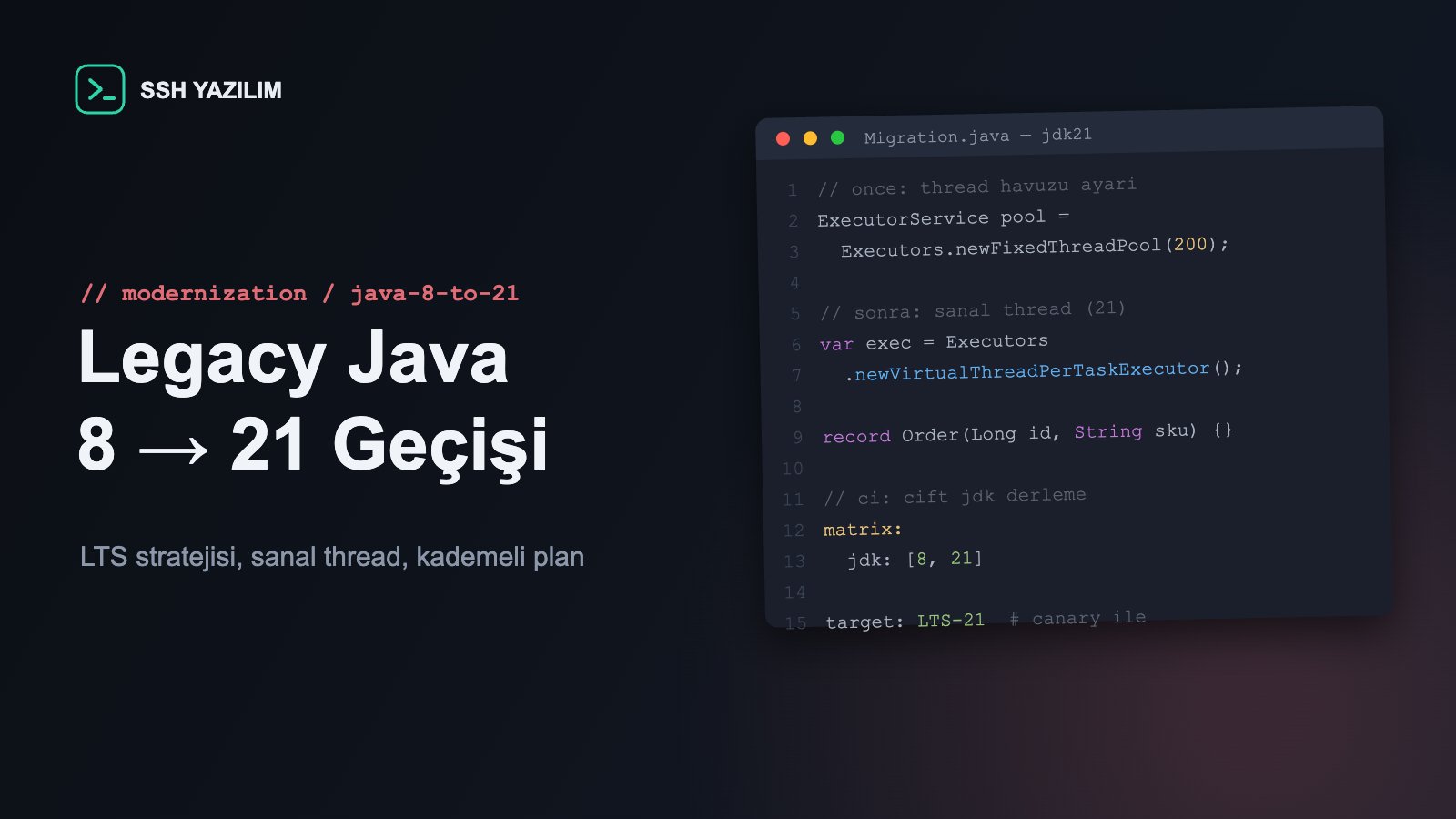
Why are we still on Java 8 — and why should we not stay?
A large share of enterprise applications still runs on Java 8, because "if it works, don't touch it" is cheap in the short term. In the long term the bill accumulates: security patch access gets harder, modern libraries drop support, performance and cost improvements pass you by, and the pool of developers who want to work on Java 8 shrinks. Modernization is not a luxury; it is an installment of technical debt whose due date has arrived.
Where to aim: the LTS strategy
Java's release model has been clear since 2017: a new release every six months, long-term support (LTS) on designated versions. The enterprise target is always an LTS — in current practice, 21 and the LTS releases after it. The right strategy is not hopping every LTS but choosing one LTS target and handling all intermediate behavioral changes in a single project. The road from 8 to 21 passes through specific breaking points — 9's module system, 11's removal of Java EE modules, 17's strong encapsulation defaults — and the migration plan is built around them.
Breaking points table
Version threshold | What changed | Typical impact |
|---|---|---|
8 → 9/11 | Module system; Java EE modules (JAXB, javax.annotation) removed from the JDK | Missing class errors; dependencies must be added |
11 → 17 | Internal API access closed by default (strong encapsulation) | Libraries reaching internals via reflection break |
17 → 21 | Virtual threads, pattern matching maturation | Opportunity for gains; little breakage |
Whole path | Removed/changed JVM flags, GC defaults | Startup parameters must be updated |
The real obstacle is not your code — it is your dependencies
Experience is consistent: application code usually compiles on the new version with small fixes; the real resistance comes from old libraries — versions reaching into internal APIs via reflection, jars depending on javax packages removed from the JDK, old bytecode-manipulating agents. That is why step one is inventory: extract the dependency tree, identify for each library the version that supports the target Java, and decide replacements for those that never will. On the Spring side this also means upgrading the Spring Boot major line; planning the framework upgrade and the JDK upgrade in one wave but as separate steps is the healthiest approach.
The gains side: features that finance the migration
In the budget conversation, gains deserve as much airtime as costs. Virtual threads (Java 21) deliver far higher concurrency with minimal change in request-per-thread applications — retiring most thread-pool tuning engineering. Modern garbage collectors (a matured G1, low-pause ZGC) reduce pause times and, indirectly, infrastructure cost. Records, pattern matching and switch improvements shrink code volume; text blocks make integration code readable. These gains are the concrete line items of the migration's business case.
The staged plan: slicing the risk
Our recommended flow has five steps. One: inventory and compatibility analysis (dependencies, JVM flags, build pipeline). Two: before moving the build, clean all warnings on the current version and strengthen test coverage — tests are the migration's insurance. Three: a dual-build period in CI: the application compiles and tests on both the old and target JDK; issues are caught before production. Four: run on the target JDK in test/staging first, observing JVM parameters and GC behavior. Five: canary deployment in production, retiring the old runtime only after a stability window. There is no big bang in this flow; every step is reversible.
Business impact: the price of risk and the cost of delay
The invisible costs of staying behind are concrete: extended support contracts, 'end-of-life runtime' findings in security audits, longer development time because modern libraries cannot be used, and a shrinking hiring pool. A planned modernization, by contrast, is a measurable, sliceable project on the order of weeks to months for most enterprise codebases. Postponement is also a decision — one that is paid back with interest.
Frequently asked questions
Can we jump straight from 8 to 21?
As a single project, yes; but the 9/11/17 breaking points must be handled in order inside it. "One target, sequential fixes" is the most efficient model.
Spring Boot first, or JDK first?
Plan by the JDK range your target Boot line supports: usually moving the application to the target Boot major first and then raising the JDK simplifies debugging.
Do virtual threads require code changes?
Little change in typical request-per-thread Spring applications; watch for code holding synchronized blocks for long periods and heavily ThreadLocal-bound patterns.
Should we rewrite the application?
A version upgrade is not a rewrite, and in most cases no rewrite is needed. Rewriting is a separate architectural discussion; merging it with modernization puts both projects at risk.
Modernization checklist
Dependency inventory and target-version compatibility map produced
Test coverage strengthened before migration
Dual-JDK build/test period established in CI
Removed javax/internal API usages identified and fixed
JVM flags and GC configuration reviewed for the target version
Staging observation window completed; canary plan ready
Gain targets (virtual threads, GC, code simplification) defined measurably
SSH Yazılım manages legacy Java version modernization end to end — from inventory to production cutover. Let us map your codebase's migration together.