
Multi-Tenant SaaS Architecture: Data Isolation Strategies
Data isolation in multi-tenant SaaS: comparing database-per-tenant, schema-per-tenant and row-level models; tenant resolution with Spring, the noisy neighbor problem and enterprise requirements.
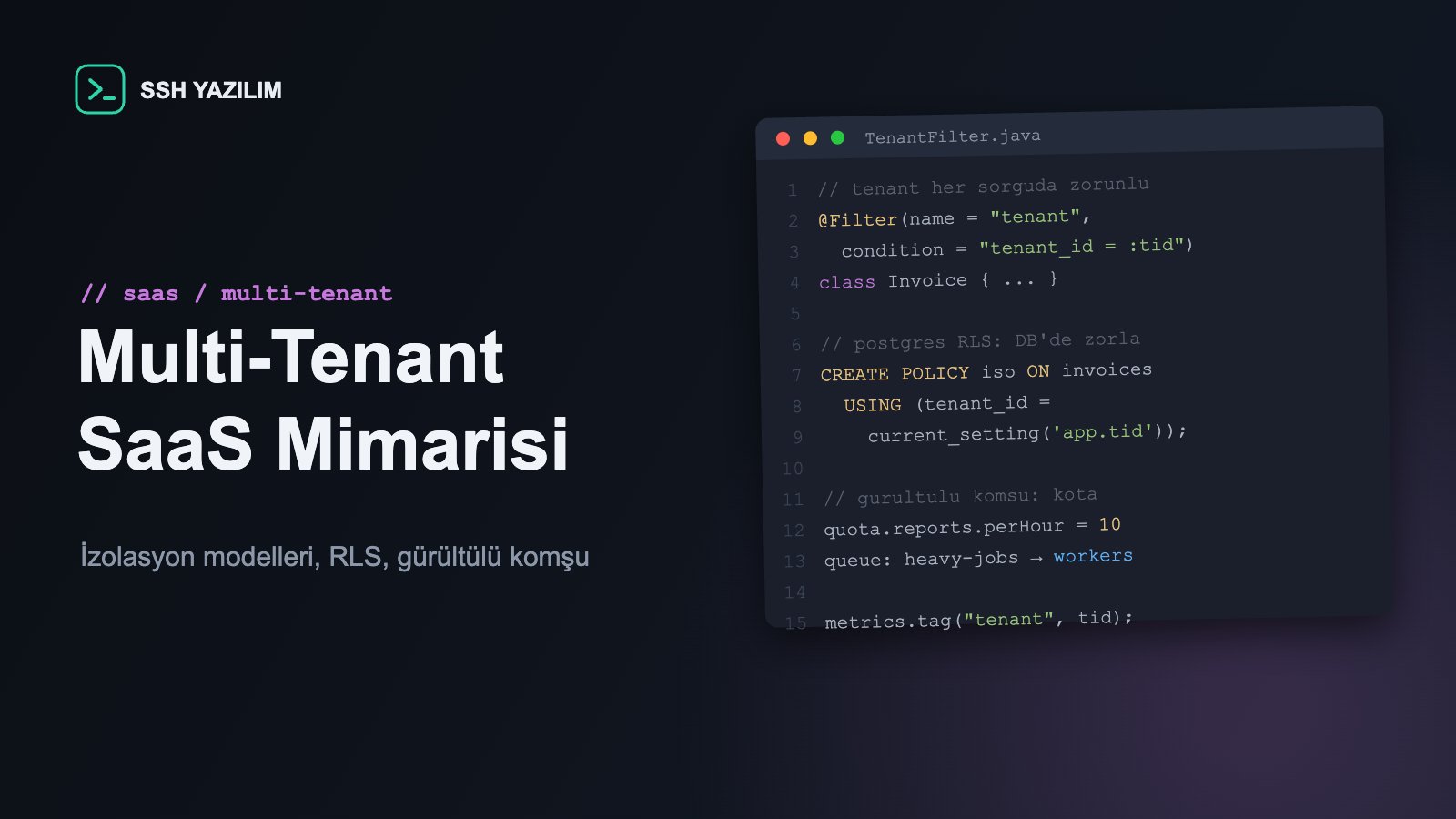
What is multi-tenancy, and what is the real question?
Multi-tenant SaaS means multiple customers sharing the same application infrastructure; the real architectural question is where the sharing ends: which resources are common, and how is whose data isolated? The decision has three dimensions — data isolation, performance isolation and the operating model — and together they determine both your cost structure and the customer segment you can sell to.
Three isolation models: the comparison
Model | Isolation | Cost | Where it fits |
|---|---|---|---|
Database per tenant | Strongest; backup/restore per tenant | Highest; connection and ops multiplier | Enterprise, regulated customers; few large tenants |
Shared DB, schema per tenant | Strong logical separation | Medium; schema management needs automation | Mid-scale; hundreds of tenants |
Shared schema, row-level (tenant_id) | Depends on application discipline | Lowest; easiest to scale | Many small tenants; self-serve SaaS |
The models are not mutually exclusive: mature SaaS products usually run hybrid — the self-serve segment row-based, the enterprise segment on separate schemas/databases. The architecture's job is to make that hybrid possible from day one.
Discipline in the row-based model: tenant_id on every query
In a shared schema, all of security reduces to one rule: no query runs without a tenant filter. That rule is not left to humans; it is built into infrastructure: resolving the tenant from the request (subdomain, header or token claim), carrying it in context, and enforcing it automatically in the data layer — Hibernate filters, Spring AOP or PostgreSQL's row-level security (RLS) are the tools. RLS is especially valuable: because the filter is enforced in the database, a forgotten filter in application code is stopped before it becomes a data leak. On the testing side, cross-tenant access scenarios must be permanent members of the regression suite.
Performance isolation: the noisy neighbor problem
Data isolation is not enough; if one tenant's heavy report slows everyone else's requests, your product is effectively not isolated. The toolset: per-tenant rate limits and quotas; heavy jobs (reports, exports, bulk imports) pushed to queues and run in separate worker pools; per-tenant metric tagging for "who is consuming" visibility; and the ability to move large tenants to dedicated resource pools when needed. Pricing meets architecture here: your quota model is the commercial face of your isolation model.
Tenant lifecycle: onboarding to offboarding
In a multi-tenant product, tenant provisioning is an orchestration, not a screen: creating schemas/databases or reserving row space, default data, permissions, domain/SSO wiring. The same rigor applies at the end: exporting data at contract end and deleting it after a defined period — KVKK/GDPR retention and deletion obligations must be operable per tenant. Automating these flows is the answer to sales' question, "can we open them tomorrow?"
Versioning and deployment: one codebase, many tenants
Multi-tenancy's economics come from a single codebase; tenant customizations are managed with configuration and feature flags, not forks. Database migrations multiply by tenant count: in schema-based models, migration orchestration (ordered, observable, reversible) is a capability of its own. Enterprise requests for "our own release window" are met with ring deployments — never with code forks.
Business impact: architecture chooses your sales segment
Enterprise buyers' security questionnaires ask the isolation model outright: where is our data, shared with whom, can it be backed up separately, does it stay in-country? A product that starts with row-based economics can sell into enterprise the day it can answer "we offer a separate schema/DB option." The reverse also holds: a product that opens a database for everyone drowns in cost in self-serve. Isolation strategy is not a technical preference; it is revenue strategy.
Frequently asked questions
Which model should I start with?
Start from the target segment: self-serve first suggests row-based + RLS; if your first customers are enterprises, schema-based builds trust. Either way, build a tenant resolution layer that can evolve into a hybrid.
Is putting tenant_id in the JWT enough?
For transport, yes; for trust, no — the claim must be verified server-side and wired into automatic data-layer filtering. No client-supplied tenant information can be an authority source by itself.
Do I need per-tenant encryption keys?
In regulated segments it is a strong sales and security tool: per-tenant keys enable cryptographic deletion at offboarding by destroying the key. Plan it together with its operational cost.
How do I detect a noisy neighbor?
Tag every metric and log with the tenant; dashboard resource consumption per tenant. Without tags, the problem only appears through customer complaints — that is, too late.
Multi-tenant checklist
Isolation model and hybrid path chosen for the target segment
Tenant resolution centralized; context carried through all layers
Automatic tenant filtering enforced in the data layer (RLS/Hibernate filter)
Cross-tenant access tests in regression
Per-tenant quotas, rate limits and metric tagging active
Onboarding/offboarding automation and deletion flows defined
Migration orchestration and ring deployments in place
SSH Yazılım designs isolation architectures and builds Spring-based implementations for multi-tenant SaaS products. Let us build your tenant architecture together.