
Oracle Database and Java: Enterprise Integration Patterns
Enterprise patterns for Oracle + Java: connection pool sizing, JPA subtleties on Oracle, the PL/SQL boundary decision, bind variable discipline and batch performance.
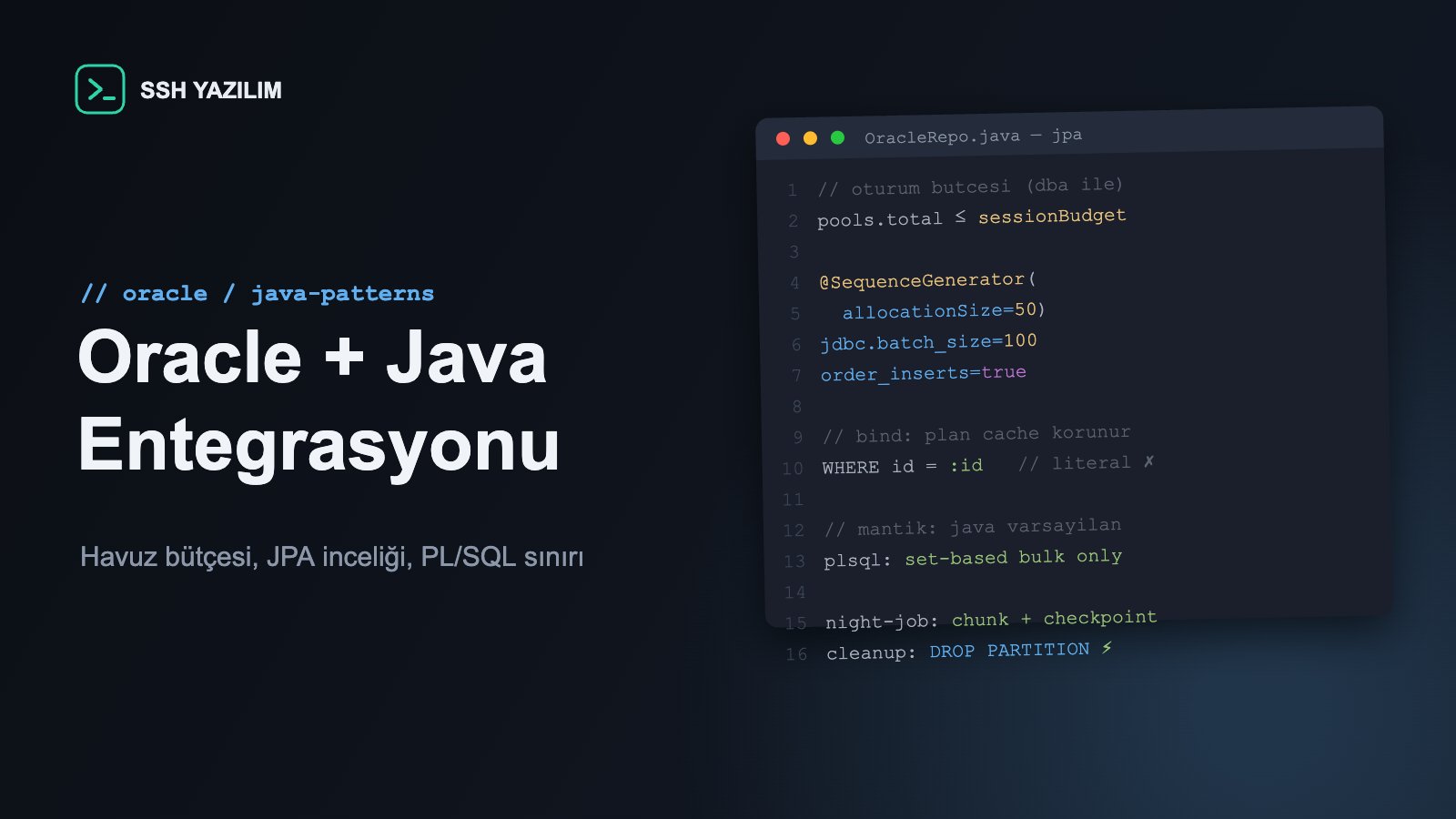
Why is the Oracle + Java pair still the enterprise standard?
Because most critical enterprise data — in Türkiye and worldwide — lives in Oracle, and the dominant language of the application layer touching that data is Java. Well-built, this pair is extremely solid; badly built, it produces a chronic complaint that starts with "the database is slow" but almost always originates in application-layer patterns. This article collects the Oracle+Java patterns we have seen in the field for years — pools, JPA, the PL/SQL boundary, batch — at enterprise standard.
Connection pools, seen from the Oracle side
The pool principles from our performance article sharpen in the Oracle context: an Oracle connection is a relatively expensive resource (server-side process/memory cost), so the 'bigger pool = faster system' fallacy costs even more here. The right practice: the sum of all application replicas' pools is sized against a session budget agreed with the DBA; pool metrics (active/waiting/wait time) are dashboarded; connection validation and leak detection are on. In multi-application estates, central management of the session budget — who may take how many connections — is part of capacity planning; teams that never discuss it eat each other's connections on campaign day.
JPA/Hibernate subtleties on Oracle
JPA runs cleanly on Oracle — provided these details are set correctly: identity generation — sequence-based with a tuned allocationSize (so not every insert visits the sequence); pagination — current versions support OFFSET/FETCH, but deep-pagination cost applies on Oracle too, and the keyset approach from our API article is the standard here as well; batch writing — without JDBC batch size + ordered insert/update settings, JPA speaks row by row and night jobs stretch into hours; large objects — a deliberate LOB access strategy; and schema alignment — clean mapping of date/time types (DATE vs TIMESTAMP) to the Java side. These five settings are the real cure for the 'Hibernate is slow on Oracle' myth.
The PL/SQL boundary: where should logic live?
Scenario | Java layer | PL/SQL |
|---|---|---|
Business rules, flow, integration | ✔ Testability, versioning, team skills | Avoid: scattered logic, hard testing |
Data-intensive bulk transformation (millions of rows) | Network round-trips costly | ✔ Processing next to the data; set-based power |
Existing PL/SQL investment (legacy packages) | Gradual migration target | Contracted use during transition |
Consistency-critical atomic operation | Most cases solved by transaction management | As the single atomic point in selected cases |
Our principle is clear: logic lives in Java by default (for tests, versioning, observability and team scaling); PL/SQL is the deliberate exception for data-heavy set operations. The worst state is an unplanned mixture — two copies of the same rule in two layers is destined to diverge. For enterprises carrying legacy PL/SQL, the strangler approach applies: packages are wrapped with contracts, new development happens in Java, migration proceeds in business-value order.
Bind variable discipline: Oracle's first rule
In Oracle, the SQL text is the key to the plan cache: queries with values embedded as literals generate a new 'unique' SQL on every call — the plan cache turns into a landfill, parse load grows, library cache contention begins. JPA/PreparedStatement usage solves this naturally; the risk hides in hand-built dynamic SQL and 'quick report' code. The audit is simple: many queries identical except for their literals is the red flag. The discipline's twin lives in security: bind variables are also the foundation of SQL injection defense — matching the rule from our security series exactly.
Batch work and night-window engineering
The invisible load of enterprise Oracle+Java systems is night jobs: reconciliation, reporting, archiving, integration feeds. The working pattern set: JDBC batch (at meaningful sizes) + sensible chunks per transaction (deliberate commit intervals — neither per-row commits nor one million-row transaction); resumability after interruption (checkpoint/idempotent chunk design — our queue article's principle again); a job-window conflict map (which job locks which table); and partition dropping for archive/cleanup jobs (the pattern from our database scaling article) so deletion takes seconds, not hours. Night-job design is daytime performance's insurance.
Business impact: yield on the investment you already made
The Oracle license and infrastructure investment already exists in most enterprises; the question is its yield. The combined effect of these patterns is concrete: higher transaction volume on the same hardware (pool + bind + batch discipline), shorter night windows, and 'the database is slow' escalations turning into evidenced diagnosis. Portability is gained too: with a clean JPA boundary, the application layer is not held hostage even if the database strategy changes later (cloud, alternative engines).
Frequently asked questions
Should I use Oracle-specific features (hints, native SQL)?
Measured and isolated: native queries are legitimate at performance-critical narrow points, but they belong inside the repository boundary with written justification. A hint culture spread across the application is both a maintenance and a portability debt.
Do RAC/Data Guard affect the application side?
Yes, at the connection and reconnection strategy level: failover-aware connection definitions, retry discipline (under the rules of our resilience article) and the decision to route read-only workloads to standby are designed together with the DBA.
Which pool should I use?
In the Spring ecosystem HikariCP is the de facto standard and works cleanly with Oracle; Oracle's own UCP is worth evaluating when RAC/failover scenarios demand its extra capabilities. More important than the choice: whichever it is, watch its metrics.
Would migrating off Oracle waste these patterns?
The opposite: a clean JPA boundary, bind discipline and batch patterns are engine-independent assets. If Oracle-specific parts stayed isolated, the migration surface is already small — the migration decision itself is a separate article's topic.
Oracle + Java checklist
Pool totals sized against a DBA-approved session budget
Sequence + allocationSize and batch settings configured
Deep pagination moved to keyset; LOB strategy deliberate
PL/SQL boundary written; duplicate-logic audit done
Bind variable audit done; literal queries cleaned
Night jobs: batch + checkpoints + conflict map + partition pruning
Oracle-specific code isolated at the repository boundary, justified
SSH Yazılım delivers performance and architecture improvement for Java systems running on Oracle, end to end. Let us raise the yield of your existing investment together.