
OWASP Top 10 Mapped to Java and Spring Projects
The OWASP Top 10 (2021) categories mapped to the Java/Spring world: a practical control map for access control, injection, misconfiguration, vulnerable dependencies and SSRF.
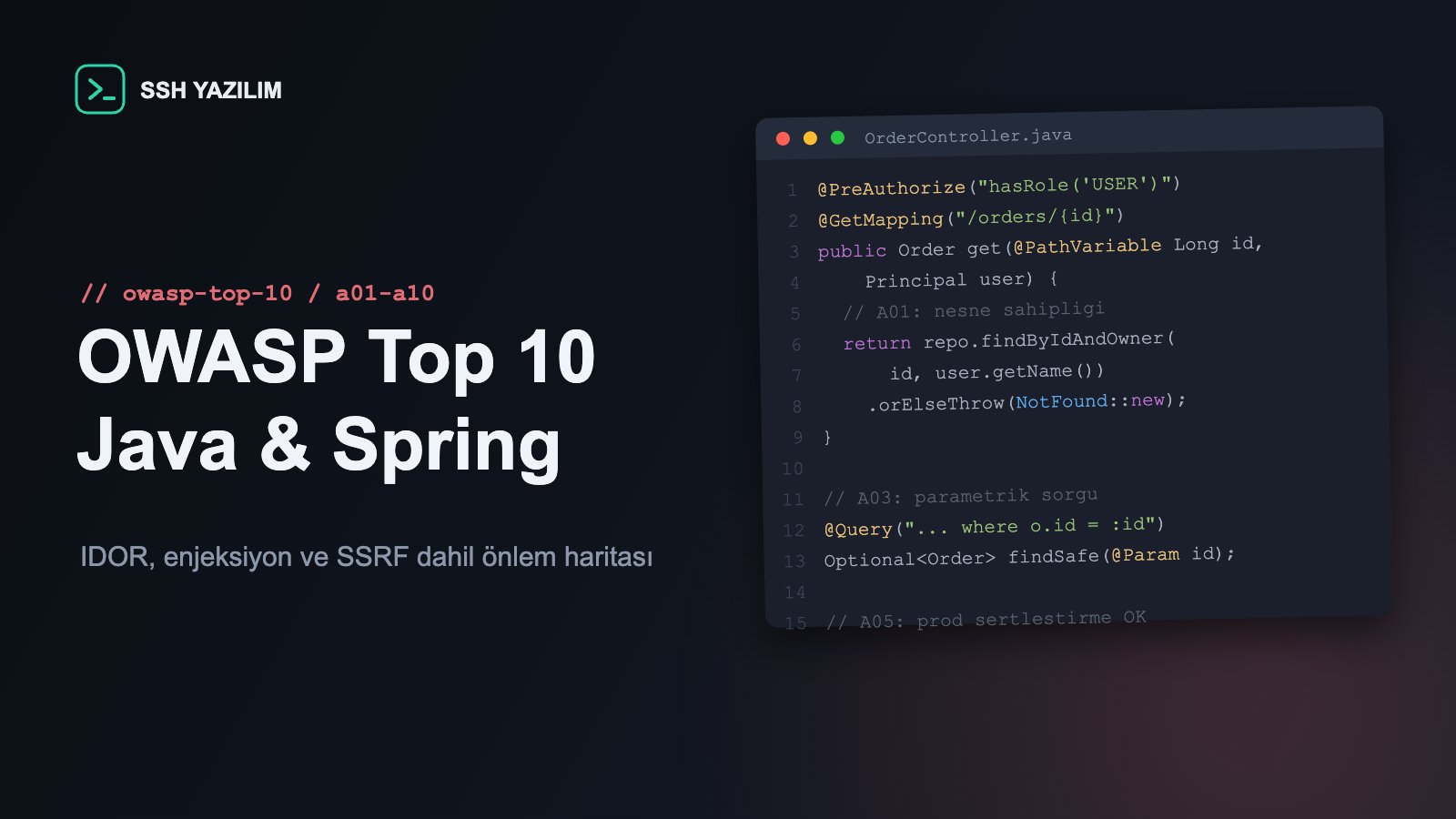
What is the OWASP Top 10 and why does it matter to Java developers?
The OWASP Top 10 is the industry's de facto standard list of the most critical web application security risks, compiled from real vulnerability data; the current edition was published in 2021. The list is language-agnostic — but every category has a concrete counterpart and a concrete control in the Java/Spring world. This article draws that map.
The 2021 list mapped to Java/Spring
Category | Typical form in Java/Spring | Primary control |
|---|---|---|
A01 – Broken Access Control | Direct object access by ID (IDOR), missing method security | @PreAuthorize + object ownership checks |
A02 – Cryptographic Failures | Weak password hashing, plain HTTP, home-grown crypto | BCrypt/Argon2, TLS everywhere, standard libraries |
A03 – Injection | Concatenated JPQL/native queries, log injection | Parameterized queries, input normalization |
A04 – Insecure Design | Building without a threat model | Threat modeling at design time |
A05 – Security Misconfiguration | Exposed Actuator endpoints, verbose error pages | Production profile hardening |
A06 – Vulnerable Components | Dependency flaws à la Log4Shell | CVE scanning in CI, SBOM, fast patching |
A07 – Identification & Authentication Failures | Weak session handling, brute-forceable logins | Spring Security session protections, rate limiting, MFA |
A08 – Software & Data Integrity Failures | Java native serialization, unverified updates | Avoiding serialization, signature verification |
A09 – Logging & Monitoring Failures | Security events leaving no trace | Audit logs, central monitoring, alerting |
A10 – SSRF | Server-side URL fetches driven by user input | URL allowlists, internal network restrictions |
A01 – Broken access control: number one on the list
This category rose to first place in OWASP's 2021 data, and its most common Spring-world form is IDOR: an endpoint like /api/orders/42 that never checks whether order 42 actually belongs to the requesting user. The fix is two-layered: role/authority checks at the endpoint via @PreAuthorize, and object ownership validation in the service. Hiding a button in the UI is not access control — every request must be verified on the server.
A03 – Injection: using an ORM does not protect you automatically
JPA/Hibernate provides strong SQL injection protection when queries are parameterized; the risk returns in JPQL or native queries built with string concatenation. The rule is absolute: user input is never appended to query text, only bound as a parameter. The lesser-known sibling is log injection: if newline characters in input are not sanitized, an attacker can forge lines in your logs.
A05 and A06 – Configuration and dependencies: the silent majority of breaches
Exposed Actuator endpoints, verbose error pages in production, default credentials — these are the Spring-world classics of A05. A06's lesson was taught by Log4Shell (CVE-2021-44228): even with flawless application code, your dependency tree is your attack surface. The shared prescription is process: a production hardening checklist, dependency scanning on every build, and a defined patch window for critical vulnerabilities.
A10 – SSRF: the rising risk of the cloud era
Any flow where your server fetches a user-supplied URL — webhook validation, image download, imports — is an SSRF door: attackers use it to reach internal services or cloud metadata endpoints. Controls: a target-domain allowlist on every outbound-request flow, rejection of internal IP ranges, and network-layer restrictions on those egress paths.
Business impact: the common language of audits
The OWASP Top 10 is the shared vocabulary of customer security questionnaires and penetration test reports. A vendor that can say "here is how we cover each OWASP Top 10 category" accelerates security review; one that cannot gets stuck in extra audit rounds during the sales cycle. Investing in this framework is also an investment in sales velocity.
Frequently asked questions
Is the OWASP Top 10 a compliance standard?
It is not a formal certification; but standards such as PCI DSS and many enterprise vendor audits reference OWASP for secure development practice.
I use Spring Security — which categories remain my responsibility?
Spring Security gives strong defaults for authentication, sessions and CSRF; but object ownership checks (A01), query discipline (A03), configuration (A05) and dependency management (A06) are entirely on the project team.
Are static analysis tools enough?
SAST/DAST tools are valuable especially for injection and misconfiguration; but they mostly cannot catch business-logic access control flaws — code review and tests are essential there.
Quick assessment checklist
Is object ownership checked on every data access?
Are all queries parameterized; has concatenation been audited?
Production profile: Actuator, error detail and default accounts reviewed?
CVE scanning and SBOM generation in CI?
Rate limiting and brute-force protection on logins?
URL allowlists on all outbound-fetch flows?
Are security events logged and wired to alerts?
SSH Yazılım performs OWASP Top 10-based code and architecture audits for Java/Spring projects. Get in touch to map your project against this framework.