
SAP Commerce and S/4HANA Integration: Flows and Architecture
Integrating SAP Commerce (Hybris) with S/4HANA: architecture of master data, pricing, stock (ATP), order and receivables flows; sync/async decisions, failure handling and reconciliation.
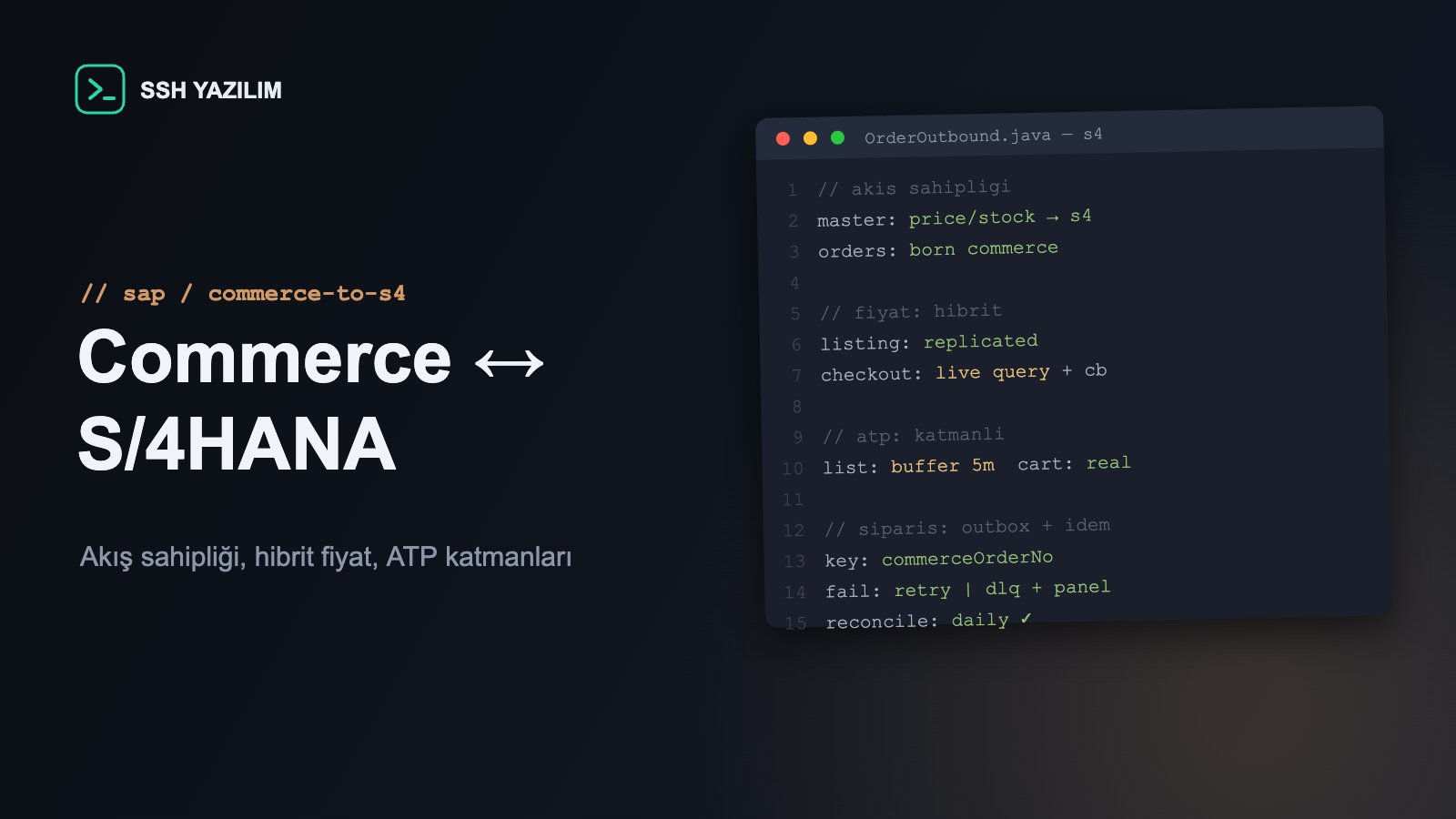
What determines success in a Commerce ↔ S/4HANA integration?
Before any technology choice, flow ownership: which system is master of which data, which flow must be real-time, which tolerates delay? An integration built without those three answers written down handcuffs two strong systems to each other — and on campaign day Commerce becomes hostage to the ERP's speed. This article takes the general patterns of our ERP integration series down into the specifics of the SAP-to-SAP line: architecture flow by flow, sync/async decisions, and reconciliation.
The flow map: who is master, which direction, what speed?
Flow | Master | Direction | Speed requirement |
|---|---|---|---|
Product master data | S/4 (or PIM) | ERP → Commerce | Bulk + delta; minutes/hours tolerated |
Pricing (list + customer-specific) | S/4 | ERP → Commerce (replication) or live query | By model: hourly in replication, instant in query |
Stock / ATP | S/4 | Commerce → ERP query + local buffer in Commerce | Instant at critical moments; cached in listings |
Orders | Born in Commerce, lives in S/4 | Commerce → ERP (async) | Queued; ERP slowness must never stop sales |
Receivables / credit limit (B2B) | S/4 | Query + threshold alerts | Current at order approval |
Order status / invoice | S/4 | ERP → Commerce | Via events/CDC within minutes |
Pricing architecture: replication or live query?
This is B2B's hardest question, because customer-specific prices live in S/4's condition technique. Two models work. Replication: price lists and conditions are periodically carried into Commerce — catalog browsing and search stay fast, campaign traffic never loads the ERP; the price is simplifying complex condition logic for transfer, plus a freshness window. Live query: at critical moments (cart/checkout) the price is fetched from S/4 in real time — accuracy is total; the price is traffic dependence on the ERP and latency. Our practical standard is hybrid: listings by replication, cart-checkout by live query (protected with caching + short TTLs + resilience patterns) — and which price difference is 'acceptable' is fixed in a written agreement with the business.
Stock and ATP: campaign day's exam
The ATP (available-to-promise) query is the gold source of accuracy, but hitting the ERP on every product card is a suicide recipe under high traffic. The layered model: buffered stock state in Commerce for listings (at in-stock/low/out level, short TTL); cached numbers on product detail; real ATP checks at add-to-cart and checkout; and for campaign products, the reservation pattern from our flash sale article (atomic decrement on the Commerce side, async notification to S/4 + reconciliation). The critical rule: a false 'out of stock' is lost sales, a false 'in stock' is cancellation cost — which mistake is cheaper for which product is a business decision, and the buffer strategy is tuned to it.
The order flow: async, idempotent, traceable
The order line's rules arrive unchanged from our ERP integration article: Commerce accepts the order and writes to a queue (atomic via outbox); transmission to S/4 happens through an async consumer; transmission is idempotent (the Commerce order number is the business key — no duplicate records on the S/4 side); failure classes are separated (transient → backoff retries; data errors → DLQ + an operations screen); and every order's integration state is queryable (received → sent to ERP → ERP confirmed → invoiced). The S/4-side counterparts (IDoc or service interfaces, whichever form is chosen) are versioned as contracts. The commercial value is crisp: an ERP maintenance window or slowdown never stops order-taking.
Channel choice and the middleware question
The channel options in the SAP world are well known: classic IDoc-based flows, OData/service interfaces and event-based approaches; whether to place middleware in between (SAP's integration suite or the enterprise's existing ESB/iPaaS) is the architectural decision. Our practical rule: keep point-to-point limited to two systems — the Commerce ↔ S/4 line can be built direct; but when third and fourth systems consume the same data (WMS, BI, marketplaces), an event/middleware architecture becomes cheaper than the total cost of repeated point-to-point lines. The decision goes into a table: consumer count, transformation needs, monitoring requirements.
Reconciliation and environment discipline
The insurance from our distributed consistency article is mandatory equipment here: end-of-day order count/amount comparison, an automatic report of stuck records (exists in Commerce, missing in S/4) and a correction runbook. Environment discipline is part of the integration too: Commerce test environments must connect to an S/4 test system (with realistic master data) — a project that 'tests the integration in production' spends go-live week doing incident management. The test-data refresh rhythm and a masked production copy policy (KVKK/GDPR compliant) are set up from the start.
Frequently asked questions
We are mid-migration from ECC to S/4; how is the Commerce integration affected?
The flow ownership map stays the same; channels and interface counterparts may change. The right practice is putting the integration behind a contract on the Commerce side (an anticorruption layer) — so the ERP migration is managed as interface adaptation without touching Commerce's internal model.
Can't real-time stock be shown everywhere?
Technically possible, economically senseless: carrying all listing traffic to the ERP spends your most expensive system on your cheapest question. The layered model brings accuracy to the moment that matters.
Is caching customer-specific prices in Commerce safe?
With per-user/account keying and permission filtering, yes — the personal-data rules from our caching article apply here to price confidentiality too: one customer's special price never lives under a shared key.
How are integration tests automated?
Contract tests (interface schemas) + record-and-replay (sample IDoc/service payloads) + end-to-end smoke scenarios (order → ERP → status back). Run in CI, this set catches 'the ERP side changed and nobody told us' surprises.
Commerce ↔ S/4 checklist
Flow ownership map (master/direction/speed) approved by the business
Pricing model chosen: hybrid replication + live query at critical moments
Stock layers and false positive/negative policy written
Order line: outbox + idempotent transmission + state tracking
Channel/middleware decision justified by consumer count
Daily reconciliation + stuck-record reports + runbook running
Test environments on realistic S/4 connections; data masking in place
SSH Yazılım builds SAP Commerce ↔ S/4HANA integrations end to end, from flow design to reconciliation discipline. Let us take your ERP line off the sales brake together.