
Contract Models in Software Projects: Fixed Price or Effort-Based?
Contract models in enterprise software: risk allocation across fixed price, time-and-materials and hybrid setups, scope/change management, acceptance criteria and matching model to project.
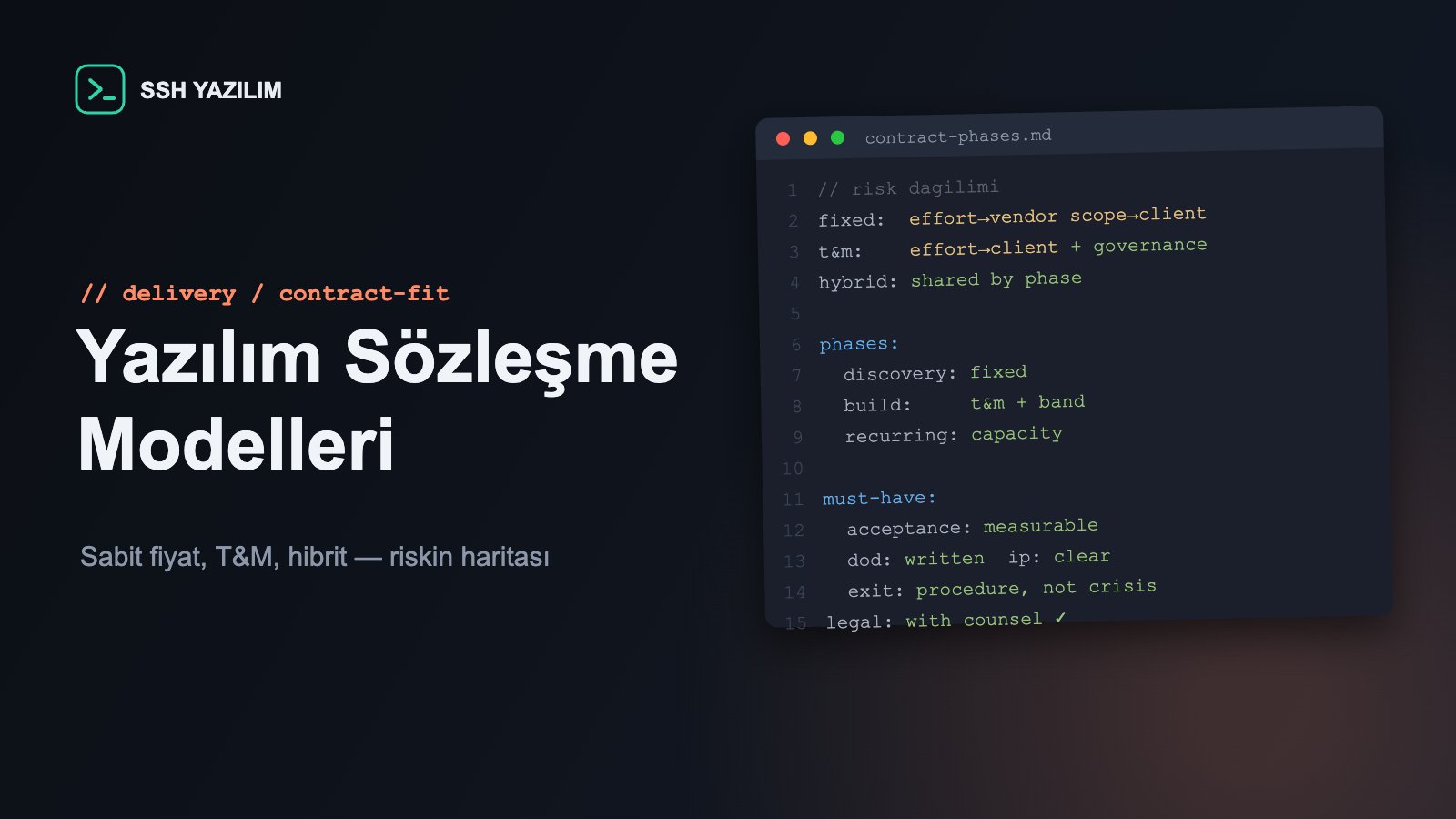
How does the contract model shape the project?
Far more deeply than assumed: the model determines which risks each side carries, how each behaves when uncertainty surfaces, and even the tone of daily collaboration. The wrong model turns two well-intentioned parties against each other; the right one aligns the same parties toward a shared goal. This article explains the three main models through risk allocation and shares the matching rules we use in our own projects. (Note: this is the business/engineering perspective; the legal text of any contract should always be finalized with your legal team.)
Three models, an honest balance sheet
Model | Who carries the risk | Strength | Weakness |
|---|---|---|---|
Fixed price / fixed scope | Effort risk on the vendor, scope-accuracy risk on the client | Budget predictability; a clear commitment | A scope-bargaining culture; change is expensive; quality under pressure |
Time and materials (T&M) | Effort risk on the client | Flexibility; adapts to discovered reality; transparency | Perceived budget uncertainty; demands governance |
Hybrid / phased | Shared, phase by phase | Commitment grows as uncertainty shrinks | Needs careful construction; both sides must understand it |
The real cost of fixed price
Fixed price reassures procurement — but it leans on an assumption that contradicts engineering reality: that scope can be fully known up front. In enterprise projects that assumption rarely holds (integration surprises, discovered requirements), and the model produces two defense mechanisms: on the vendor side a risk premium (uncertainty is baked into the price — the client pre-pays insurance they may never use), and on the process side change-request bureaucracy (every deviation becomes a negotiation; energy drains from product into contract). Fixed price's legitimate territory is genuinely low-uncertainty work: a well-defined integration, an upgrade after an upgrade rehearsal, a modernization phase with proven scope, assessment/audit engagements.
Setting up time and materials properly
T&M is the model of flexibility, but it is not a blank check — built that way, it loses trust. The proper setup comes with governance: a budget ceiling and warning thresholds (actuals versus estimate, visible monthly), sprint/period goals (outcomes discussed, not effort: which capabilities ship this period), transparent recording (who, on what, how long — no question marks) and ease of exit (termination on reasonable notice — the most honest quality guarantee is the client not being forced to stay). In that frame, T&M is the natural model of discovery-heavy work: new product development, extensive modernization, R&D-flavored features.
Hybrid setups: commitment proportional to certainty
The healthiest construction we find in the field ties commitment inversely to uncertainty: a fixed-price discovery phase (assessment, architecture design, PoC — crisp scope, document/decision outputs), goal-bounded T&M implementation phases (a phase goal + a budget band: 'this phase covers these capabilities within this band' — band-overrun risk managed by early signals) and a capacity model for recurring work (the base-capacity + improvement-share setup from our AMS article). The phase gates from our modernization consulting article find their commercial counterpart here: every gate is the opportunity to update the next phase's model and budget.
Non-negotiables, whatever the model
Whichever model is chosen, four areas determine the contract's quality. Acceptance criteria: 'it works' is a subjective phrase; acceptance binds to measurable criteria (functional scenarios + performance targets + security scan results — the metrics from our earlier articles become contract language here). Definitions: the definition of done (are tests, documentation, deployment included), defect classification and warranty-period behavior. Intellectual property and delivery scope: clarity on source code, documentation and handed-over access. The separation scenario: even the best relationships end; if regular delivery (code + documents + knowledge transfer) lives in the contract, separation is a procedure, not a crisis. The presence of these clauses also signals the vendor's self-confidence — the party avoiding them is the question mark.
Business impact: the model is the relationship's operating system
Choosing a contract model looks like a one-off procurement decision; in reality you are choosing the operating system of a months-long collaboration. The cost of a mismatch accumulates in behavior, not on the invoice: scope defense under fixed price, drift under ungoverned T&M. The right match channels energy into the product — and evolves the vendor relationship from project-based transactions toward a technology partnership. How to evaluate that evolution is the topic of this series' closing article.
Frequently asked questions
Management wants fixed price, but the work is discovery-heavy; what now?
The phased setup exists precisely for this tension: buy the discovery phase at a fixed price; its output is a realistic estimate of implementation; the implementation commitment is made on that evidence. Instead of 'fixing the unknown', make the unknown cheaply knowable.
What happens when a budget band is exceeded?
In a good setup it is never a surprise: threshold warnings arrive early and three options reach the table — scope prioritization (fit the band), a justified band revision, or stopping at the phase gate. Having no options is a construction error.
Do penalty clauses improve quality?
In our experience, not on their own — they produce defensive behavior. Measurable SLAs + incentive balance (like the incident-reduction incentive in our AMS article) align better than penalties; penalties should remain an exceptional safeguard.
Do small engagements need this much contract detail?
Proportional to scale: for small work, a one-page statement of work + acceptance criteria + a standard framework agreement suffices. The point of detail is not bureaucracy but the existence of a written answer at the moment of uncertainty.
Contract model checklist
The work's uncertainty profile assessed; model chosen accordingly
In phased setups, every gate is a model + budget update point
In T&M: ceiling, threshold warnings and period goals defined
Acceptance criteria measurable; definition of done written
IP, delivery scope and warranty behavior clear
Separation scenario: regular delivery + knowledge transfer in the contract
Legal text finalized together with the legal team
SSH Yazılım works with transparent contract constructions proportional to uncertainty — from discovery phases to capacity models. Let us build the right model for your project together.